
FIND DATA: By Author | Journal | Sites   ANALYZE DATA: Help with R | SPSS | Stata | Excel   WHAT'S NEW? US Politics | Int'l Relations | Law & Courts
   FIND DATA: By Author | Journal | Sites   WHAT'S NEW? US Politics | IR | Law & Courts
If this link is broken, please report as broken. You can also submit updates (will be reviewed).
Neighbors Change Votes: How Local Social Pressure Shapes Partisan Switching
Insights from the Field
partisanship
neighborhoods
social influence
panel data
survey
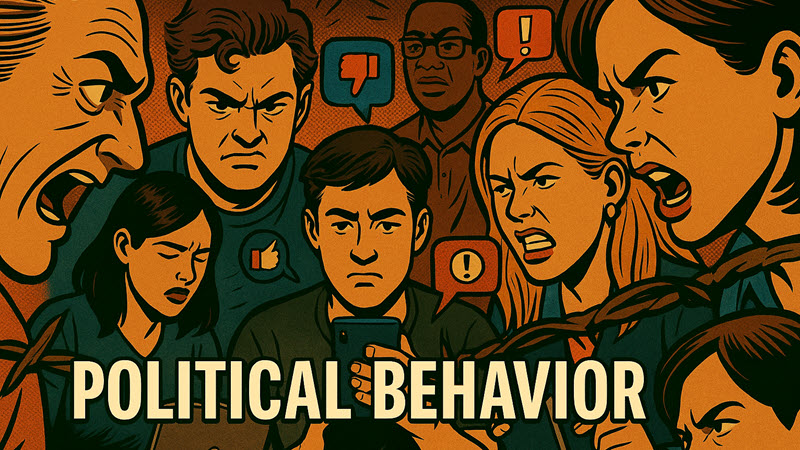
Political Behavior
JOP
114 R files
32 Datasets
2 Text
17 Other
6 Archives
Dataverse
Partisan Conversion Through Neighborhood Influence: How Voters Adopt the Partisanship of Their Neighbors was authored by Jacob Brown. It was published by Chicago in JOP in 2025.

📊 Voter Records Covering 41 Million People (2008–2020):

Longitudinal voter files track partisan registrations and switches across U.S. neighborhoods from 2008 through 2020. These records are used to measure how exposure to partisan neighbors correlates with individual party switching over time.

🧾 Original Survey of 24,433 Residents:

A contemporaneous survey of 24,433 respondents probes perceptions and social interactions in local places to test whether social influence explains the patterns seen in the voter records.

🔑 Key Findings:

  • Exposure to partisan neighbors increases the likelihood that a voter will switch party affiliation.
  • Effects of neighbor partisanship on switching are largest for:
  • Older voters,
  • Residents of single-family-home communities,
  • Voters who have more same-race neighbors.

🔍 Evidence on How Influence Works:

  • Voters accurately perceive the partisan composition of their immediate neighborhoods.
  • Residents interact more frequently with neighbors who share the same party.
  • Voters report greater comfort and political fit when their own partisanship matches nearby neighbors.

📌 Why This Matters:

These results show that partisanship is not only a product of national cues or individual predispositions but is actively shaped by local social environments. Geographic clustering of partisans therefore has behavioral consequences: where people live—and who they live near—helps determine party affiliation and contributes to political polarization at the neighborhood level.
data
Find on Google Scholar
Find on JSTOR
Find on Chicago Press
Journal of Politics
Podcast host Ryan

