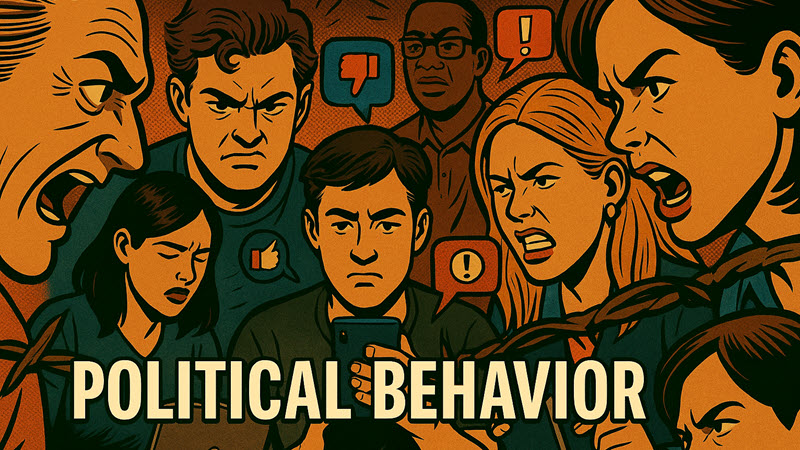
Political communication studies often rely on captive participants who passively receive messaging. This article challenges that approach by exposing participants to health care policy framing experiments where they can actively choose information.
Key Finding: Allowing individuals to select their own news dramatically shifts results, showing strong early frame persistence and resistance to later frames—what we call 'staunch opinion stability'—contrary to previous assumptions about gradual opinion change.
Why This Matters: Our findings suggest that this phenomenon reflects biased information seeking in the real world. It also highlights a fundamental disconnect between experimental lab settings (captive participants) and how citizens actually form opinions, with implications for understanding political polarization, normative evaluations, and health care debates.
| A Source of Bias in Public Opinion Stability was authored by James N. Druckman, Jordan Fein and Thomas J. Leeper. It was published by Cambridge in APSR in 2012. |