
FIND DATA: By Journal | Sites   ANALYZE DATA: Help with R | SPSS | Stata | Excel   WHAT'S NEW? US Politics | IR | Law & Courts🎵
   FIND DATA: By Journal | Sites   WHAT'S NEW? US Politics | IR | Law & Courts🎵
WHAT'S NEW? US Politics | IR | Law & Courts🎵
If this link is broken, please
You can also
(will be reviewed).

Why Democracies Thrive in International Crises: A New Look at the Data

International Relations subfield banner

This paper examines why democratic states tend to win international crises. It tests multiple theories about democratic political systems against a dataset of 422 conflicts from 1918-1994.

🔍 Data & Methods

Drawing on established frameworks, we analyze crisis outcomes using regression analysis and compare findings across different theoretical lenses.

đź’ˇ Key Findings

• Democracies do not simply avoid conflict but selectively engage in disputes where they can prevail • Their political systems help explain why leaders are more responsive to domestic audiences during international crises • The democratic peace phenomenon appears genuine despite earlier debates about its causes • Audience costs—a consequence of democratic accountability—play a crucial role in crisis decision-making

📚 Why It Matters

Our results offer clearer insights into the mechanisms behind democratic peace theories, suggesting that democratic institutions themselves shape state behavior rather than just reflecting common interests.
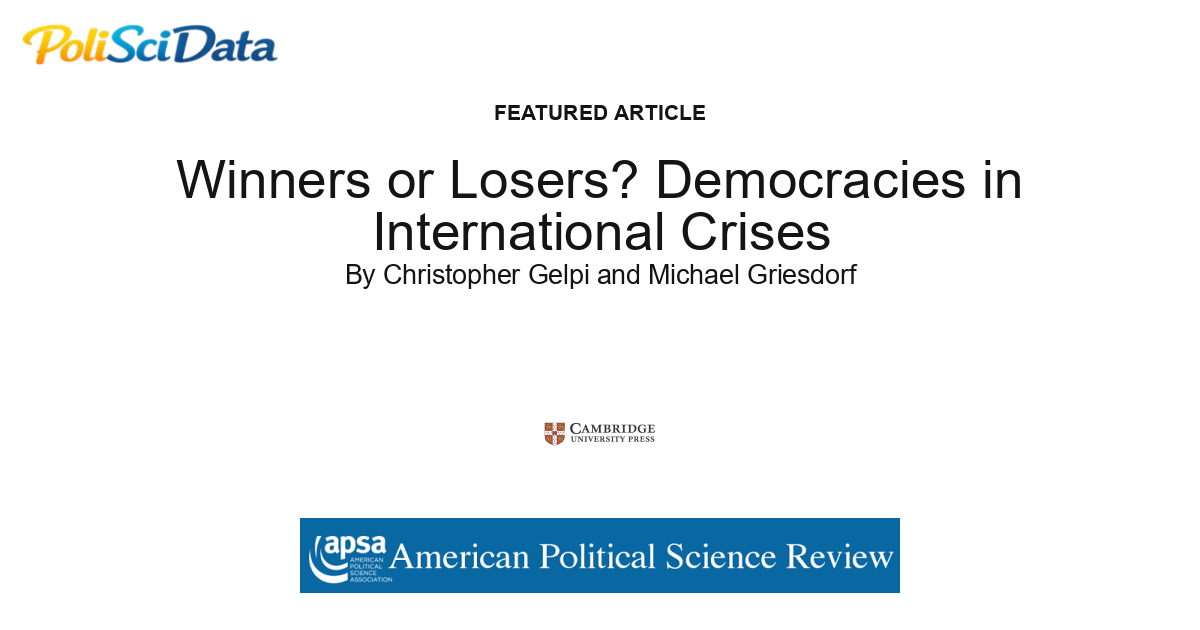
Article card for article: Winners or Losers? Democracies in International Crises
Winners or Losers? Democracies in International Crises was authored by Christopher Gelpi and Michael Griesdorf. It was published by Cambridge in APSR in 2001.
Find on Google Scholar
Find on Cambridge University Press
American Political Science Review

