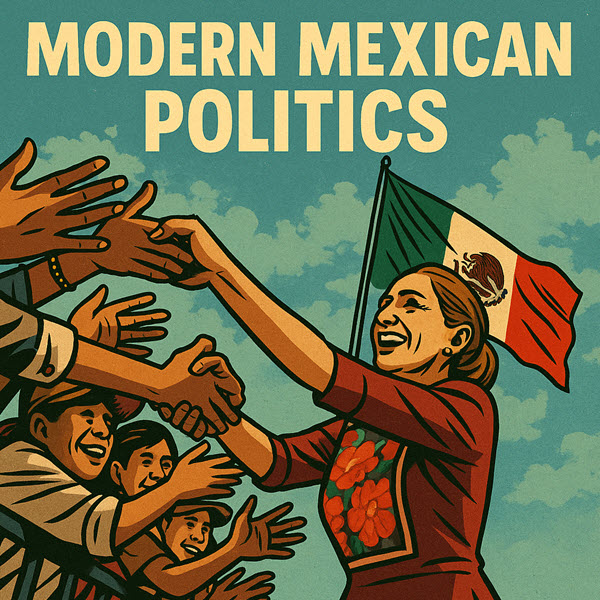
About This Feature
This special issue of political science articles on Mexican politics focuses on a range of contemporary challenges and dynamics,
employing robust data analysis to explore various facets of governance, policy, and social issues. Together, these studies
provide a comprehensive and data-driven exploration of Mexican political life. Featuted on web site Summer 2024.
Replication Data from Peer-Review Studies

Why Do Drug Cartels Use High-Profile Murders in Mexico?Article summary
Drug cartels openly murder government officials and party candidates during periods of intense political polarization. This article investigates why criminal organizations would choose such tactics despite typically preferring bribery over violence, suggesting that this strategic decision is linked to their goal of establishing control within local communities.
Agents or Partisans? New Study Reveals Why Mexican Teachers Union Wins ElectionsArticle summary
Political brokers like Mexico's SNTE mobilize voters globally, but what drives their success?
Mexico's Drug War Fears: Do They Deter Voters from Corruption?Article summary
New survey and experiment data explore how fear of violence during Mexico's Drug War influences voter attitudes toward corruption. In nationally representative surveys before the 2012 presidential election, researchers discovered a link between exposure to crime and increased acceptance of corruption as a means to reduce violence.
Paradox: Military Weapons Improve Police Image in Mexico Despite Violence LinksArticle summary
Many developing countries increasingly deploy the military for domestic policing (constabularization) even though prior research suggests this approach can be counterproductive. This study asks whether visual features of armed actors—such as weapons, uniforms, gender, and skin tone—shape public views of law enforcement across several dimensions: perceived effectiveness, respect for civil liberties, proclivity for corruption, and acceptance of militarization in one’s neighborhood.

How Surname Polling Stations Reveal Ongoing Election Fraud in MexicoArticle summary
New evidence suggests that electoral fraud persists in Mexican elections despite the country's democratic progress.
Repressive Defamation Laws Chilling in Mexican Media, Study FindsArticle summary
New research reveals that stricter defamation legislation in Mexico reduces press coverage of corruption.
Electoral Reform Shifted Mexican Trade Policy Toward Local IndustriesArticle summary
Anthony Pezzola investigates how changes in political institutions reshaped who benefits from Mexican trade policy. The article shows that the rules that link politicians to voters — especially electoral reforms that strengthen territorially specific constituencies — can redirect political protection and preferential treatment away from nationally important industries and toward firms that matter most within subnational jurisdictions.

Social Networks Help Incumbents Dodge Accountability After All?Article summary
This study investigates how social networks shape political accountability in Mexico.
AI Detects Election Fraud: 1988 Mexico's Hidden Ballots RevealedArticle summary
Was Mexico's 1988 election truly free? New analysis reveals AI-powered detection using an original database of vote tally sheets uncovered widespread fraud.
Mexican Reform Lifts Reelection Ban; Legislators Focus More On Election-Friendly PoliciesArticle summary
The 2014 Mexican Electoral Reform ended an eighty-year ban on reelection for legislators. This study uses a quasi-natural experiment approach to examine how this change affects political behavior.
Commodity Shocks Ignited State Building After Mexico's RevolutionArticle summary
Elite Competition and State Capacity Development: Theory and Evidence from Post-Revolutionary Mexico
Party Unity in Mexico: Discipline Resists Nomination Rule Changes Despite Personal Vote BanArticle summary
How does party discipline form under institutional constraints? We argue that even when personal vote cultivation is banned, as in the Mexican Chamber of Deputies, it depends on parties' electoral incentives. Candidate selection rules only affect legislative behavior conditionally.

Same-Sex Recognition in Mexico vs US Shows Surprising Rights ProgressArticle summary
This article compares civil rights advancements for LGBTQ populations across two federal systems: the United States and Mexico.
Why Democracies Struggle with Brutality: Institutional Failures in MexicoArticle summary
Societies face a challenge in restraining coercive institutions like the police force to create more humane criminal justice systems.
Mexican Businesses Link Violence Exposure to Higher Social Spending SupportArticle summary
Social and political violence in Mexico makes business interests more receptive to social welfare spending. This paper presents survey experiment results from Mexican business owners and operators showing increased support for anti-poverty measures tied to institutional weakness, while decreasing preference for tax cuts.
Also see Journal Data Archives