FIND DATA: By Journal | Sites   ANALYZE DATA: Help with R | SPSS | Stata | Excel   WHAT'S NEW? US Politics | IR | Law & Courts🎵
   FIND DATA: By Journal | Sites   WHAT'S NEW? US Politics | IR | Law & Courts🎵
WHAT'S NEW? US Politics | IR | Law & Courts🎵
If this link is broken, please
You can also
(will be reviewed).

Private Ballot Secrecy Ads Boost Election Turnout, Two Experiments Show

Ballot SecrecyVoter Turnout Experiment2014 Midterm ElectionsPrivate Nonpartisan MailingVoting and Elections@PSR&M4 Stata files1 datasetDataverse
Voting and Elections subfield banner

Doubts about ballot secrecy persist and depress voter participation in the U.S.🚫

New experiments suggest private groups can help. 🔥

* A nonpartisan nonprofit sent mail emphasizing ballot secrecy to nonvoters during the 2014 election, 🗳️ resulting in a ~1 percentage point turnout increase among recently registered voters.

* This effect is precisely estimated and robust across different state political contexts. ✅

But wait: 🔍

* The increase was not statistically significant when compared to standard voter mobilization appeals (reminder + encouragement). 🤔

This finding has important implications for understanding how campaign messaging influences elections in the U.S.🃏 and points toward future research directions. 💡
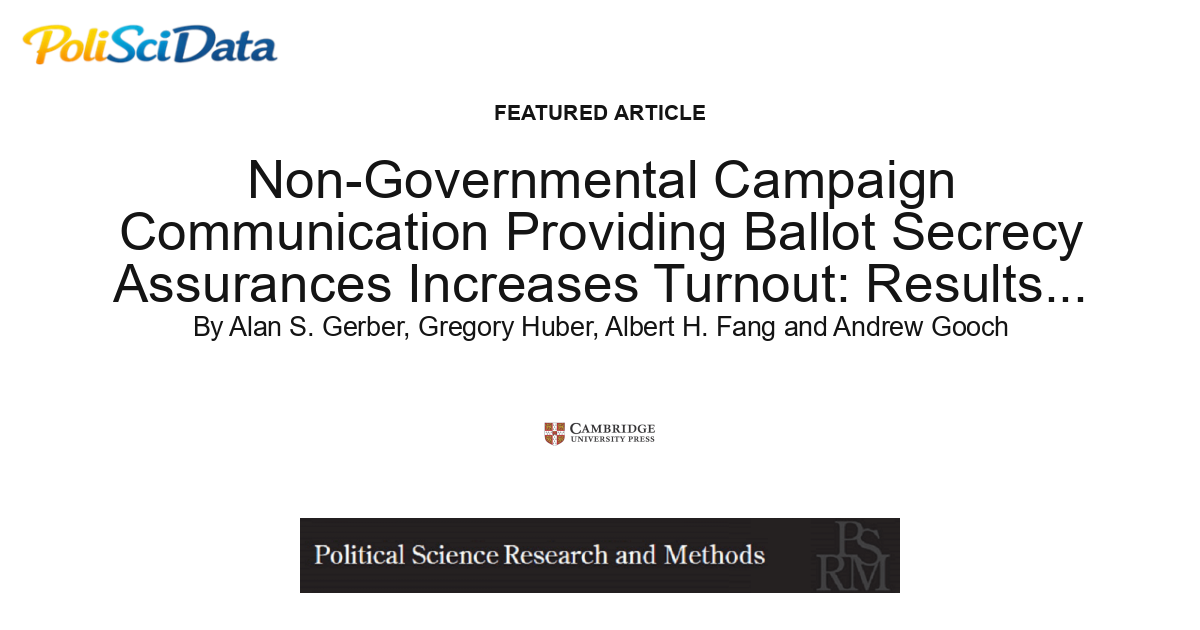
Article card for article: Non-Governmental Campaign Communication Providing Ballot Secrecy Assurances Increases Turnout: Results from Two Large Scale Experiments
Non-Governmental Campaign Communication Providing Ballot Secrecy Assurances Increases Turnout: Results from Two Large Scale Experiments was authored by Alan S. Gerber, Gregory Huber, Albert H. Fang and Andrew Gooch. It was published by Cambridge in PSR&M in 2018.
Find on Google Scholar
Find on Cambridge University Press
Political Science Research & Methods