
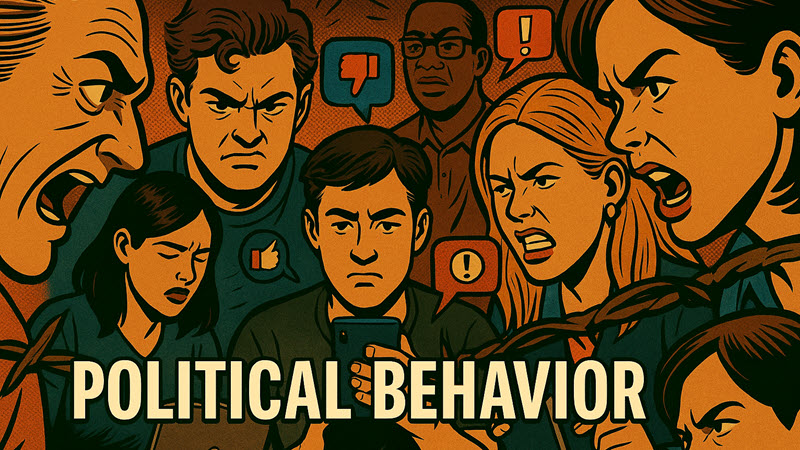
Why Voters Sometimes Don't Punish Democratic Violations?
Natasha Wunsch, Marc S. Jacob, and Laurenz Derksen ask why voters often fail to sanction candidates who violate democratic norms. The authors build on debates about heterogeneous democratic attitudes to show that people’s differing conceptions of what democracy means affect whether they recognize—and therefore punish—anti-democratic behavior at the ballot box.
How the Study Measures What 'Democracy' Means
The paper links individual-level measures of democratic preferences to observable voting behavior. Rather than treating support for democracy as uniform, the authors classify citizens by how strongly they endorse liberal democratic norms (e.g., minority rights, rule of law) versus more permissive or nonliberal understandings of democracy.
A Candidate-Choice Conjoint Experiment in Poland
To estimate behavioral consequences of these differing understandings, the authors run a candidate-choice conjoint experiment in Poland, a competitive democracy that has experienced sustained backsliding. The experiment presents respondents with hypothetical candidates who vary on democratic and non-democratic attributes, allowing the authors to observe how candidate violations affect choice conditional on voters’ democratic attitudes.
Key Findings
What This Means for Research and Politics
The study identifies political culture—specifically, the absence of broad attitudinal consolidation around liberal democracy—as a neglected factor in explanations of democratic backsliding. For scholars and policymakers, the results imply that defending democracy requires more than institutional checks: it also depends on cultivating shared commitments to liberal democratic norms among citizens.
| The Demand Side of Democratic Backsliding: How Divergent Understandings of Democracy Shape Political Choice was authored by Natasha Wunsch, Marc S. Jacob and Laurenz Derksen. It was published by Cambridge in BJPS in 2025. |


