
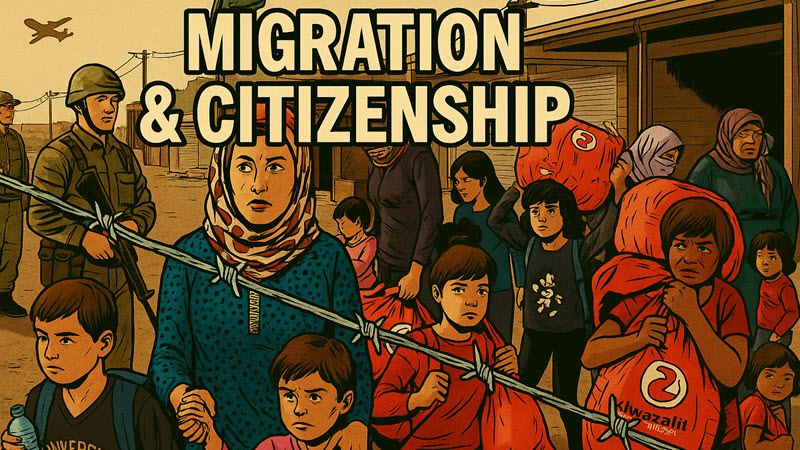
Why This Question Matters
Seminal theories in political science hold that military service can accelerate minority and immigrant integration into mainstream society by providing skills, social networks, and civic bonds. But estimating whether service causes better long-term outcomes is difficult because individuals who join the military may already be more likely to integrate.
How Nan Zhang and Melissa Lee Identify Causal Effects
Zhang and Lee exploit the natural experiment created by the U.S. Vietnam-era draft lotteries (1970–72), which assigned conscription risk by date of birth. Using those lottery numbers as an instrumental variable for military service, the authors isolate exogenous variation in service rates to estimate causal effects on later-life integration.
What the Study Measures
The analysis focuses on immigrants who were subject to draft risk during the Vietnam era and links draft-induced variation in service to integration outcomes observed in the 2000 decennial census. The authors use an instrumental-variables design to separate the impact of service from preexisting differences that drive who enters the military.
Key Findings
What This Means for Theory and Policy
For the Vietnam-era conscription context, the research challenges a straightforward integrationist interpretation of military service: benefits attributed to service in observational studies may reflect selection rather than causal effects. The findings highlight important scope conditions for claims that military service promotes immigrant integration and caution against generalizing from correlational relationships without accounting for selection into service.
| Military Service and Immigrants' Integration: Evidence from the Vietnam Draft Lotteries was authored by Nan Zhang and Melissa Lee. It was published by Cambridge in APSR in 2025. |


