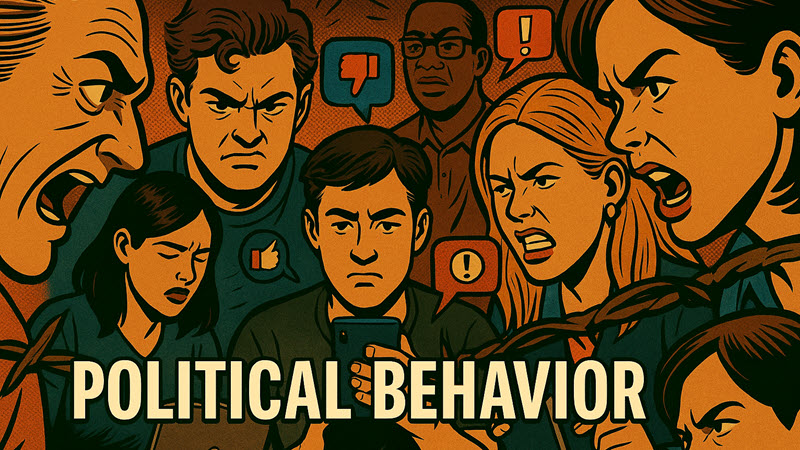
Why Some Partisans Hold Strong Attachments?
Scott Clifford investigates why some people form intense attachments to political parties while others do not. The paper tests the idea that individual differences in moral psychology—specifically the Moral Foundation of Loyalty, which captures a tendency to value group bonds and obligations—help explain variation in partisan strength. This question matters because partisan strength predicts turnout, polarization, and political engagement, and clarifying its roots helps link moral psychology to core political behavior.
How the Study Was Designed
Clifford uses two independent samples—a national panel and a convenience sample—and multiple operationalizations of moral foundations to test whether Loyalty predicts how strongly people identify with their party. The analysis explicitly tests alternative explanations, including measures of patriotism, ideological extremity, and directional (policy-driven) accounts of partisanship, to see whether Loyalty contributes uniquely to partisan attachment.
What the Evidence Shows
What This Means for Theories of Partisanship
The findings strengthen the view of partisanship as a social identity shaped in part by moral predispositions. By linking the Loyalty foundation to partisan strength, the study provides a psychological source for why some citizens become deeply attached to parties—beyond ideology or strategic incentives—and points to moral foundations as a promising avenue for explaining heterogeneity in political commitment.
Implications for Research and Practice
These results encourage political scientists to incorporate moral-psychological traits when modeling partisan behavior and polarization. They also caution that efforts to change partisan attachments may encounter deep-seated moral orientations that shape group loyalty.
(Author: Scott Clifford; Journal: POLBEH)
| Individual Differences in Group Loyalty Predict Partisan Strength was authored by Scott Clifford. It was published by Springer in Pol. Behav. in 2017. |