
NOW AVAILABLE: Essentials of Poltical Analysis 7e | R Companion 4e | SPSS 7e | Stata 5e | Excel 1e 🎵
NOW AVAILABLE: Essentials 7e | R Companion 4e | SPSS 7e | Stata 5e | Excel 1e 🎵
NOW AVAILABLE: Essentials 7e | More Textbooks 🎵

The Essentials of Political Analysis, Sixth Edition

An earlier edition of Essentials

The sixth edition of The Essentials of Political Analysis introduced students to the reasoning behind political research and the interpretation of statistical evidence. It connected concepts and measurement with hypotheses, research design, ethical choices, and comparisons that help evaluate explanations. Later chapters developed inference, significance tests, measures of association, linear regression, and logistic regression. Examples, tables, figures, and practical exercises linked statistical ideas to substantive political questions. The book concluded with guidance for conducting an independent analysis. Published in 2019, this edition remains a reference for earlier courses and research.

The seventh edition is the current edition, with revised coverage and updated examples. Visit its page for current book information and teaching resources.
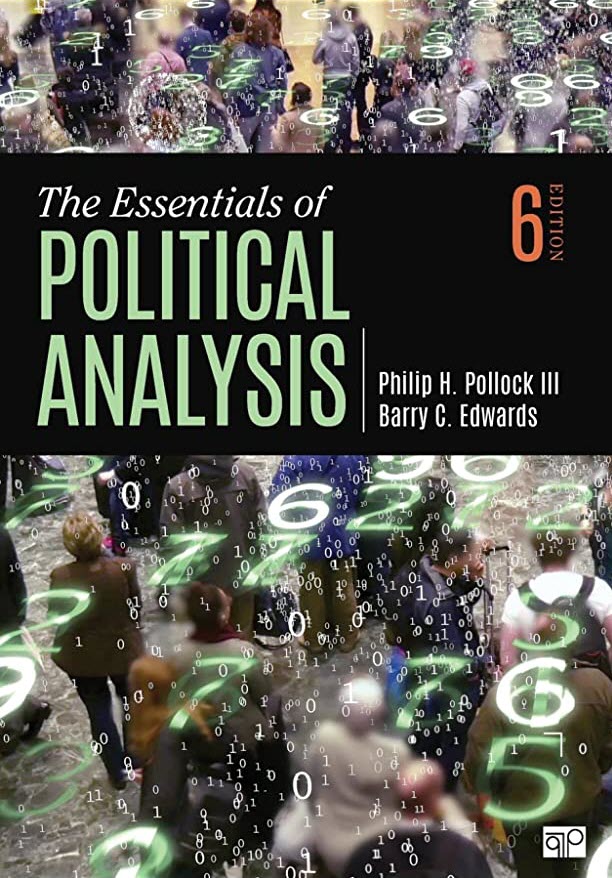
The Essentials of Political Analysis, Sixth Edition cover

Book Information

Authors
Philip H. Pollock III and Barry C. Edwards
Edition
Sixth edition
Publisher
CQ Press, an imprint of Sage
Publication
2019
Pages
368
Paperback ISBN
9781506379616

Earlier-Edition Archive

Sixth-edition links

These links are retained for earlier courses and research. They relate to the sixth edition and may differ from current-edition resources.

Sixth-Edition Contents

Chapter titles are retained here as a reference to the sixth edition.

  • Introduction (A Scientific Approach to Politics)
  • 1. The Definition and Measurement of Concepts
  • 2. Measuring and Describing Variables
  • 3. Proposing Explanations, Framing Hypotheses, and Making Comparisons
  • 4. Research Design, Research Ethics, and Evidence of Causation
  • 5. Making Controlled Comparisons
  • 6. Foundations of Statistical Inference
  • 7. Tests of Significance and Measures of Association
  • 8. Correlation and Linear Regression
  • 9. Logistic Regression
  • 10. Conducting Your Own Political Analysis