FIND DATA: By Journal | Sites   ANALYZE DATA: Help with R | SPSS | Stata | Excel   WHAT'S NEW? US Politics | IR | Law & Courts🎵
   FIND DATA: By Journal | Sites   WHAT'S NEW? US Politics | IR | Law & Courts🎵
WHAT'S NEW? US Politics | IR | Law & Courts🎵
If this link is broken, please
You can also
(will be reviewed).

Income Inequality Shapes Who Wants to Fight: A New Look at War Motivation

International Relations subfield banner

This study examines citizens' willingness to fight in war using six waves of the World Values Survey. It finds that military motivation varies significantly by income inequality levels and socioeconomic status.

Findings:

• Willingness to fight decreases with country-level income inequality

• Wealthy individuals are more likely to seek alternatives to military service in unequal societies

• Poorer citizens show less variation in fighting willingness across different inequality contexts

Mechanism: These results suggest that high income inequality creates a 'burden sharing' dynamic where the wealthy can avoid direct risks while poorer segments of society bear the burden.

Policy Implications: The findings highlight how economic disparities may influence public support for military action and potentially shape intervention policies in unequal societies.
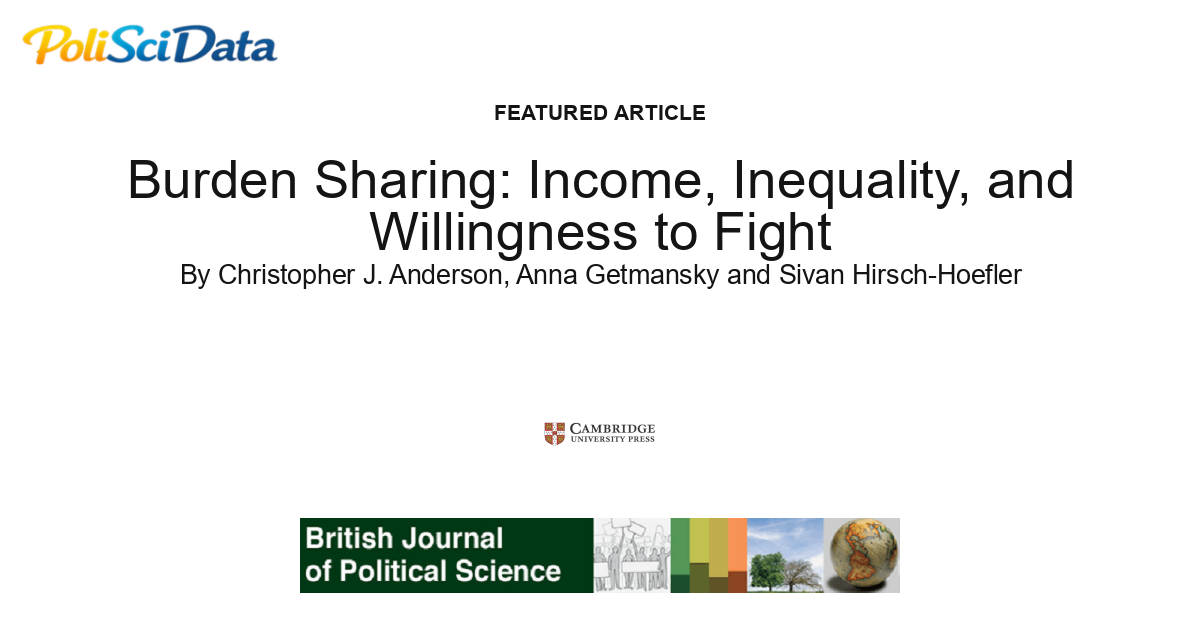
Article card for article: Burden Sharing: Income, Inequality, and Willingness to Fight
Burden Sharing: Income, Inequality, and Willingness to Fight was authored by Christopher J. Anderson, Anna Getmansky and Sivan Hirsch-Hoefler. It was published by Cambridge in BJPS in 2020.
Find on Google Scholar
Find on Cambridge University Press
British Journal of Political Science