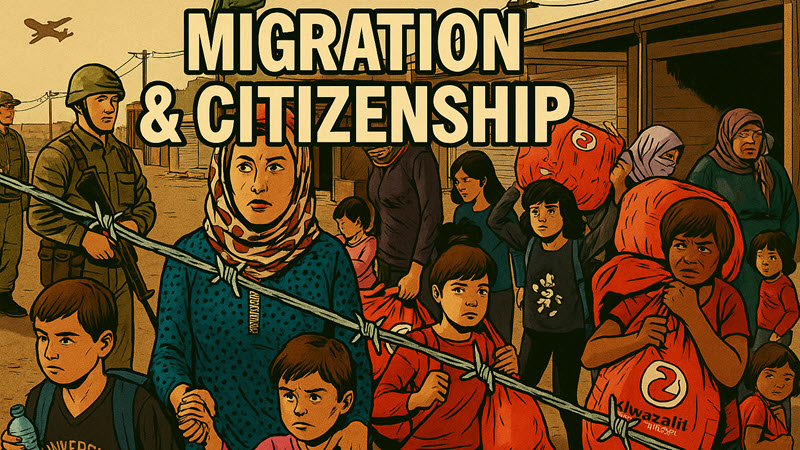
This article asks how Members of the European Parliament (MEPs) represent Syrian and Ukrainian refugees and whether implicit hierarchies of race and gender shape those representations. Drawing on Critical Securitisation Theory, the authors compare discursive patterns to test a hypothesis that stigmatisation based on race and gender affects EU representations of refugees. The manuscript reports a computational comparison of EP speech acts to see when refugees are cast as urgent threats and when speech enables de‑threatening or protective framings.
Comparative text-analysis Critical Securitisation Theory Structural Topic Modelling Gender-based victimisation
Data and methods
The study uses computational text‑analysis tools applied to European Parliament discourse. The abstract names Word- and Bigram-Frequency Analysis, TF-IDF and Structural Topic Modelling as the analytic toolkit used to compare representations of Syrian and Ukrainian diasporas. The framing of the research is explicitly discursive and comparative, focusing on speech acts in EP debates rather than on quantitative outcome measures.
Main findings
According to the abstract, the analysis does not simply find a straightforward securitisation of Syrian refugees grounded only in racialised language; it also uncovers a process of de-personalisation in how some MEPs justify anti-migration positions. For Ukrainian refugees, the authors expected cultural-proximity narratives to deconstruct threat framings, but instead report a pattern of gender‑based victimisation that contributes to protective policy responses by the EU.
- Syrian refugees: de-personalisation alongside elements that justify anti-migration stances.
- Ukrainian refugees: emphasis on gendered victimhood linked to protective measures.