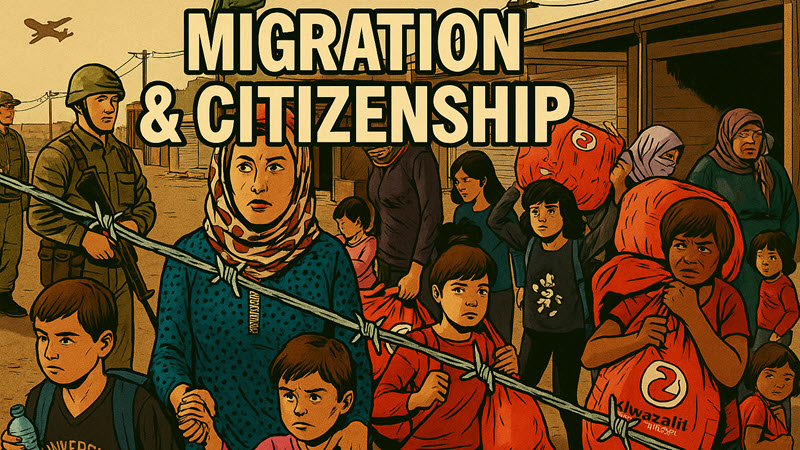
This study asks how cross-border labor migration changes migrants’ redistribution preferences, comparing migrants themselves to their left-behind family members. Using a randomized intervention that facilitated labor migration from India to the Middle East, the authors test whether moving alters support for taxation and redistribution and explore mechanisms tied to economic gains, self-reliance, and expectations of upward mobility.
Field-randomized intervention Comparison with left-behind family members Measured change in support for taxation and redistribution
Data and methods
The authors report results from a randomized controlled trial that facilitated labor migration from India to the Middle East. The intervention produced high rates of cross-border migration; the abstract identifies a field experiment design and contrasts outcomes for migrants and their non-migrating family members.
Main findings
According to the abstract, migrants who moved as a result of the intervention became less supportive of taxation and redistribution. The authors attribute this shift not only to economic gains but also to psychological changes—greater self-reliance and belief in upward mobility—while noting that left-behind family members did not become more fiscally conservative despite also receiving economic benefits.
- Migrants showed a significant reduction in support for taxation and redistribution.
- Left-behind family members did not show the same shift even when experiencing economic gains via remittances.