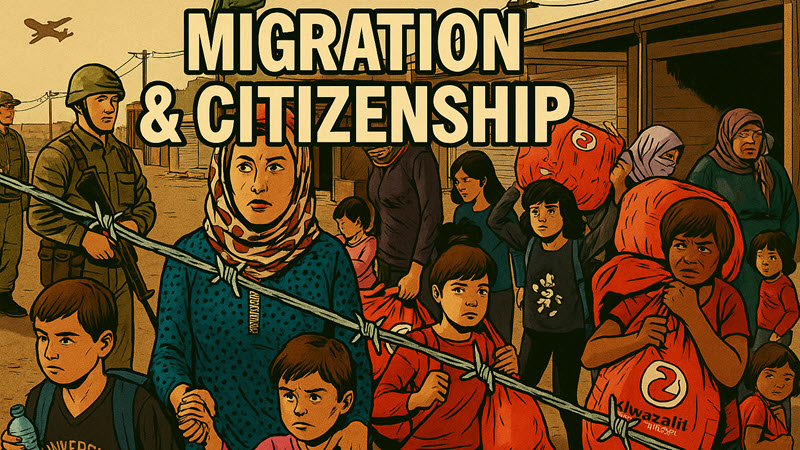
This article asks whether states’ freedom-of-foreign-movement policies affect human trafficking flows and how spatial context matters. Using cross-national data, the authors test competing claims that open borders either enable traffickers by reducing detection or that restrictive movement increases vulnerability to traffickers. The central contribution is to show that considering a state’s own mobility rules together with neighboring states’ practices is necessary to understand how freedom of movement relates to trafficking.
Cross-national panel analysis, Attention to local and neighborhood policy divergence, Human-trafficking flows as outcome
Data and methods
The study uses data from 182 countries covering 2001–2017 to test the relationship between freedom of foreign movement and human trafficking flows. The abstract frames the analysis as a cross-national, time-series test of competing policy claims about openness versus restriction; it emphasizes comparing a country’s policies with those of its neighbors.
Main findings
The authors report that it is both theoretically and empirically necessary to consider freedom of foreign movement at the local and neighborhood level. Specifically, they find that freedom of movement increases human trafficking when a country’s practices diverge from those of its neighbors, highlighting a spatial interaction rather than a uniform effect of openness or restriction.
- The analysis directly weighs competing hypotheses: openness might reduce detection and raise trafficking, while restrictions might increase vulnerability.
- The key empirical claim is conditional: effects of freedom of movement depend on whether local and neighborhood practices align or diverge.