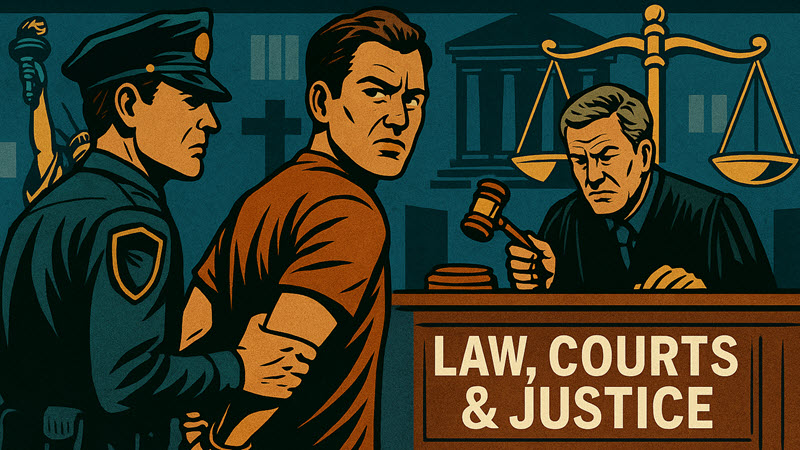
Why This Matters
Judges shaping new areas of law face uncertainty about how a case fits with existing legal rules. Those early decisions can produce inconsistent law across circuits, affecting predictability for litigants, lower courts, and policymakers. Anthony Taboni explores how ideological differences between appellate courts shape that process of legal learning.
The Puzzle and Theory
Taboni builds a formal model of judicial decision making where courts encounter issues of first impression—legal questions without settled precedent—and learn from prior appellate rulings. The theory predicts two central dynamics: courts learn most readily from ideologically similar peers, but increasing ideological distance between courts can either raise or lower legal uniformity depending on whether a prior decision aligns with a court’s relative bias.
Data: First-Impression Cases in the U.S. Courts of Appeals
The paper tests the model using an original dataset of cases of first impression from the U.S. Courts of Appeals. These are rulings where circuits confront novel legal questions and thus have the opportunity to be influenced by decisions in other circuits.
Key Findings
What This Means For Courts and Litigation
Taboni’s findings illuminate why circuit splits emerge and persist, and how the ideological configuration of the federal courts affects the path of law. The paper has implications for strategic litigation, the likelihood of Supreme Court review, and scholars’ understanding of precedent formation in a fragmented appellate system.
| The Path of Law: Legal Uncertainty and Issues of First Impression in the U.S. Courts of Appeals was authored by Anthony Taboni. It was published by Cambridge in APSR in 2025. |