Why This Matters
Misinformation threatens public health, democratic governance, and social trust. Priyadarshi Amar, Sumitra Badrinathan, Simon Chauchard, and Florian Sichart test whether sustained classroom instruction can produce durable improvements in how people evaluate information and whether those gains spread beyond students to their households.
A Classroom-Based Trial in Bihar
The authors partnered with a state government agency in Bihar, India to implement a four-month curriculum aimed at building skills, shifting norms, and increasing knowledge about health-related misinformation. The intervention reached 13,500 students across 583 villages in a field experiment designed to estimate intent-to-treat effects of the program.
How Effects Were Measured
Outcomes focused on students' ability to distinguish true from false information and on behavioral indicators of information use. Measures included tests of discernment between true and false claims, stated health preferences, reported reliance on scientific sources, and reported use of unreliable news outlets. A follow-up survey conducted four months after the end of the curriculum tested persistence of effects and whether gains generalized to political misinformation. The study also examined within-household spillovers by assessing parents of treated students.
Key Findings
What This Means for Policy and Research
The results show that a sustained, classroom-based curriculum can produce measurable and persistent improvements in information discernment and can spill over to family members. These findings suggest schooling-based interventions are a promising component of long-term strategies to counter misinformation, especially in settings where short-term fact-checking or media interventions may have limited reach. Future work should explore scalability, cost-effectiveness, and which curriculum elements drive the largest gains.
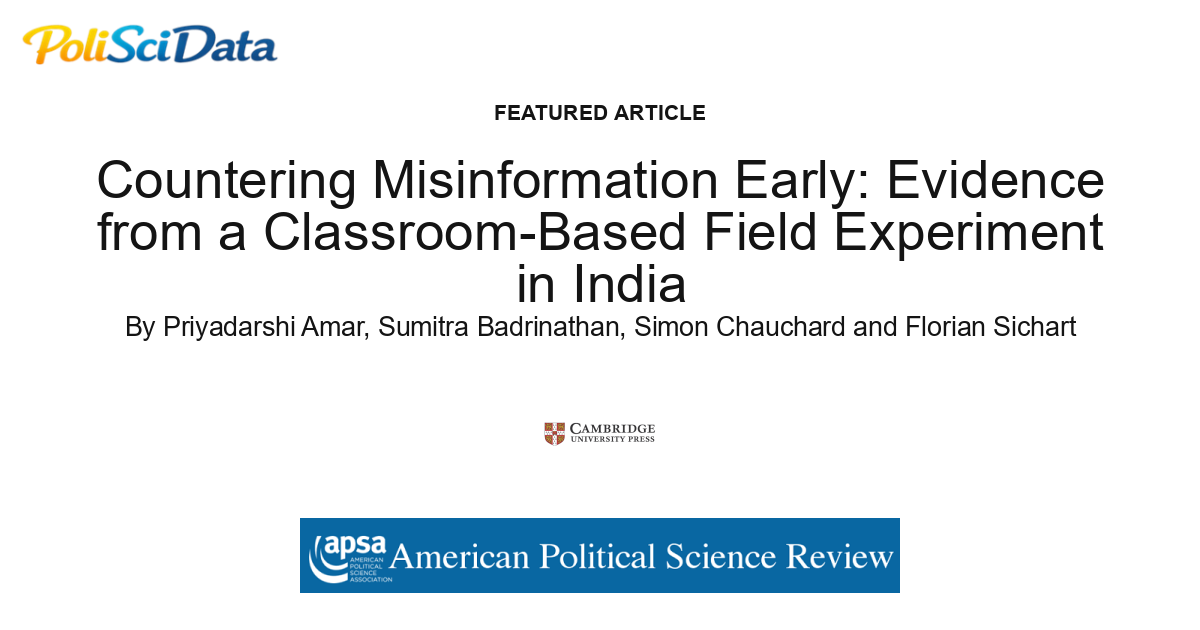
| Countering Misinformation Early: Evidence from a Classroom-Based Field Experiment in India was authored by Priyadarshi Amar, Sumitra Badrinathan, Simon Chauchard and Florian Sichart. It was published by Cambridge in APSR in 2025. |