
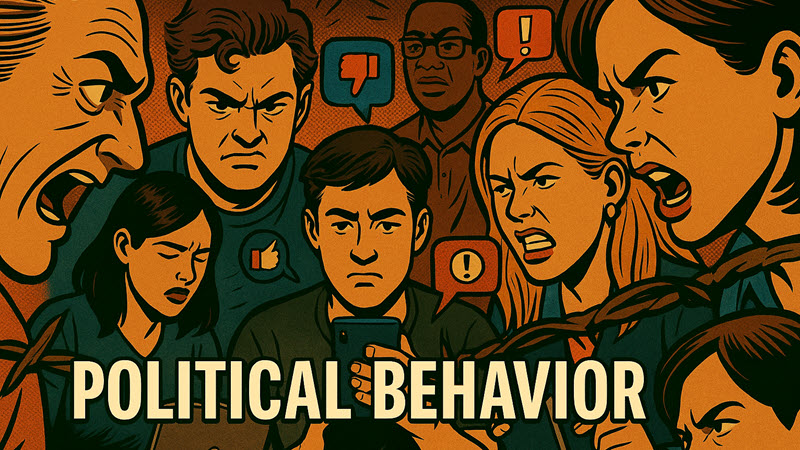
Why Political Norms Hold?
Vicente Valentim (BJPS) investigates what keeps political norms — shared beliefs about which opinions and behaviors are socially acceptable — in place within democracies. The study focuses on norms against radical-right preferences, a well-established boundary in many democracies, and asks how ordinary citizens detect and enforce breaches of those norms.
What Valentim Did
The paper uses a survey in Spain in which respondents viewed pictures of individuals presented as holding different political views and reported their reactions. This design isolates how respondents evaluate and respond to visible signals of political preference. Measures include expressed disapproval and willingness to impose social sanctions on the pictured individuals.
Key Findings
What This Means for Democratic Politics
By documenting how citizens signal disapproval and apply mostly indirect sanctions, Valentim identifies a micro-level mechanism of social influence that helps stabilize political norms. These everyday enforcement practices help explain why certain political preferences—here, radical-right positions—remain stigmatized in public life, with implications for how political boundaries are maintained and how dissenting voices are socially managed.
Where to Look Next
The study highlights the value of experimental survey designs for tracing norm enforcement and suggests further work on cross-national variation, long-term effects of sanctioning on political behavior, and the consequences for democratic pluralism.
| The Enforcement of Political Norms was authored by Amalia Alvarez-Benjumea and Vicente Valentim. It was published by Cambridge in BJPS in 2024. |


