
Why This Question Matters
Civil wars often devastate local markets and cut off livelihoods. Understanding whether UN peacekeeping missions do more than stop violence — whether they help revive local economies and sustain gains after withdrawal — matters for mission design, exit planning, and development policy in conflict-affected areas.
What the Authors Do
Deniz Cil, Hanne Fjelde, Lisa Hultman, Nils W. Metternich, and Desirée Nilsson conduct a large-N subnational study of UN peacekeeping operations to estimate how the presence and subsequent withdrawal of peacekeepers affect local economic activity in civil war countries.
How Economic Activity Is Measured
The authors combine geocoded data on peacekeeping deployments with high-resolution nighttime lights data, a widely used proxy for local economic activity and infrastructure use. This approach lets them track economic dynamics at fine spatial scales where traditional economic statistics are often unavailable.
Research Design and Methods
Key Findings
What This Means for Policy and Research
The results suggest that UN peacekeeping can deliver not only short-term security benefits but also measurable local economic gains that persist, albeit gradually, after forces leave. These findings point to the importance of coordinating peacekeeping, aid, and development planning around mission exit to sustain and amplify economic recovery in post-conflict settings.
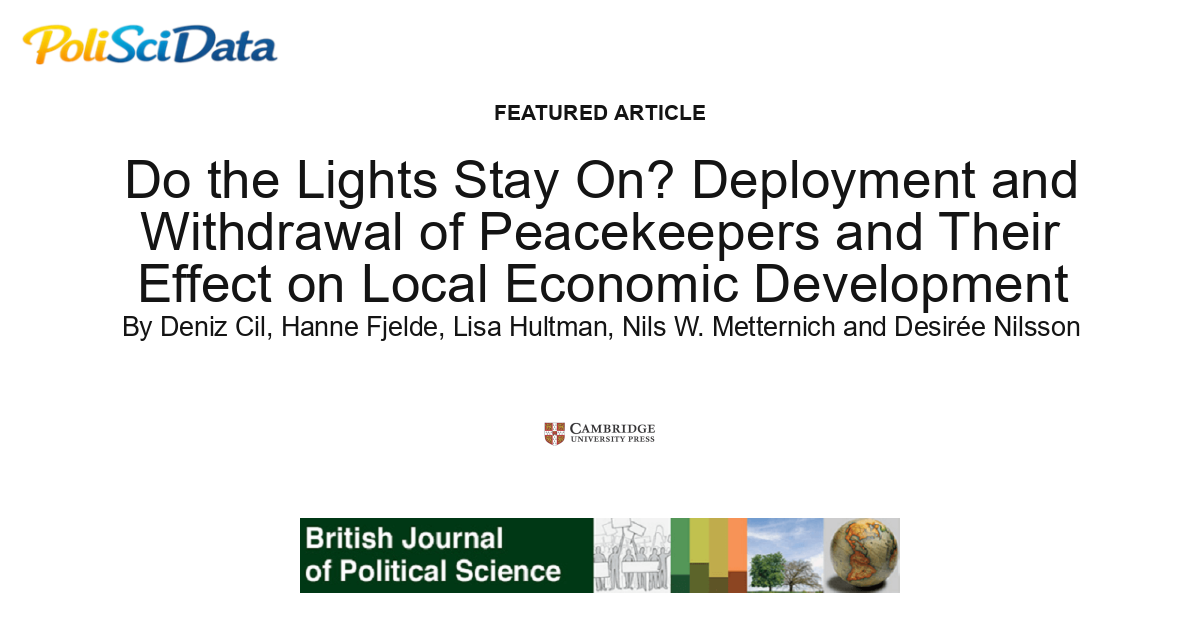
| Do the Lights Stay On? Deployment and Withdrawal of Peacekeepers and Their Effect on Local Economic Development was authored by Deniz Cil, Hanne Fjelde, Lisa Hultman, Nils W. Metternich and Desirée Nilsson. It was published by Cambridge in BJPS in 2025. |


