
Why This Question Matters
Illiberal political actors in Western democracies increasingly frame the protection of liberal values—like gender equality and LGBTQ+ rights—as a reason to demonize ethnic and religious out-groups. Stuart J. Turnbull‑Dugarte, Alberto López Ortega, and Michael Hunklinger ask whether ordinary citizens actually endorse a common stereotype that Muslims are inherently illiberal and a threat to LGBTQ+ communities.
What the Authors Did
The authors use an original double‑list experiment designed to reduce sensitivity and social‑desirability bias in responses. That design allows them to estimate, at the population level, how many people in each country privately hold the stereotype that Muslims oppose or threaten LGBTQ+ rights. The investigation covers four countries: Britain, Germany, the Netherlands, and the United States.
Key Findings
Why It Matters for Scholarship and Policy
By using a design that minimizes respondents' reluctance to report sensitive beliefs, the study provides stronger evidence that prejudicial stereotypes about Muslims and illiberalism are embedded in mass attitudes in multiple Western democracies. This finding matters for scholars tracing the cultural foundations of exclusionary politics and for policymakers and civic actors concerned with social cohesion: persistent stereotype‑based threat perceptions can shape support for discriminatory policies and empower political actors who mobilize on those perceptions.
The paper appears in the British Journal of Political Science and advances measurement of sensitive attitudes while documenting cross‑national patterns in a politically consequential stereotype.
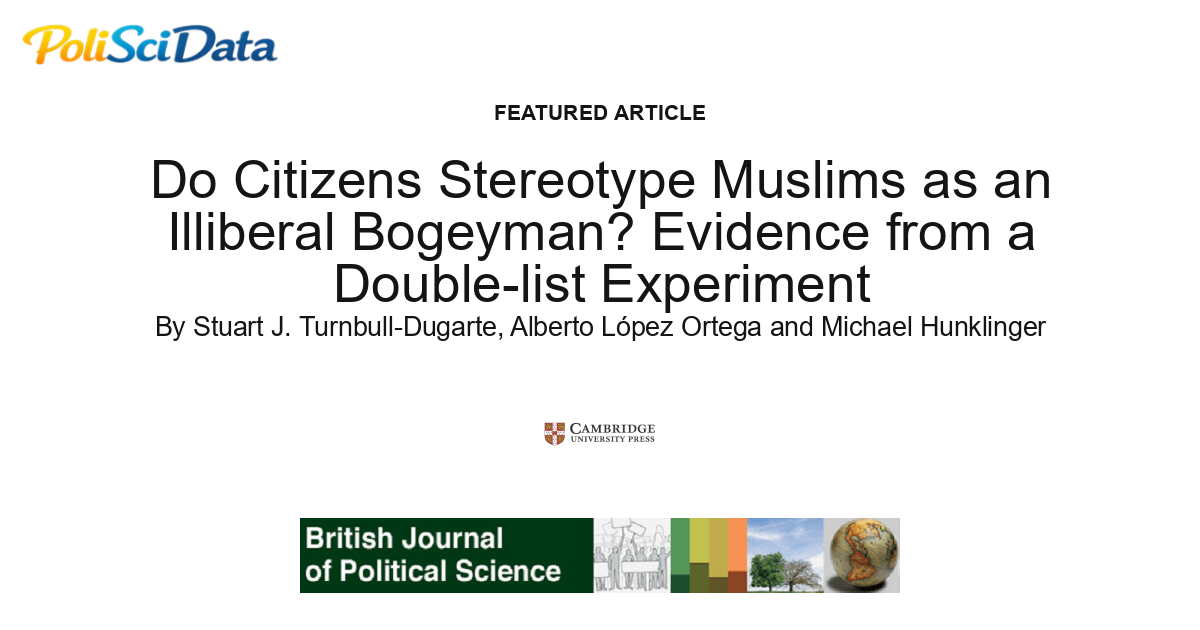
| Do Citizens Stereotype Muslims as an Illiberal Bogeyman? Evidence from a Double-list Experiment was authored by Stuart J. Turnbull-Dugarte, Alberto López Ortega and Michael Hunklinger. It was published by Cambridge in BJPS in 2025. |


