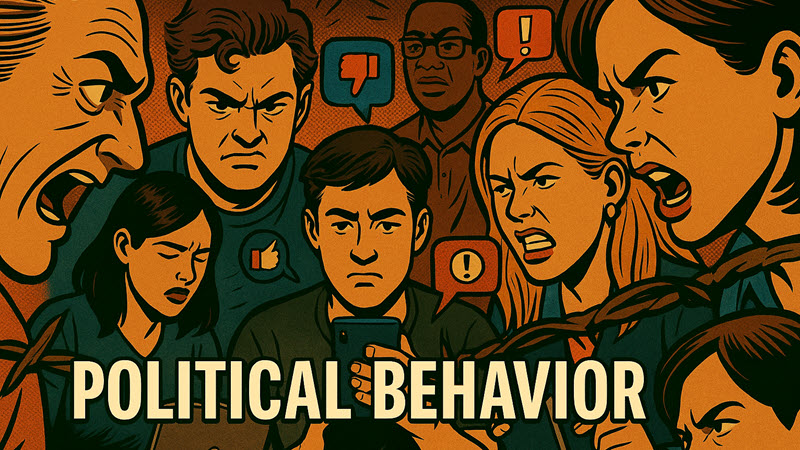
What Jin Woo Kim Asks
Jin Woo Kim (BJPS) investigates when and why partisans reject political evidence that contradicts their side. The study tests whether resistance to uncongenial information is a stable feature of partisan cognition or whether it depends on the emotional context in which information is received.
How the Study Works
The article reports two preregistered survey experiments that expose partisans to the same pieces of congenial and uncongenial evidence. In both experiments, subjects were randomly assigned to conditions that either left affective context neutral or induced a feeling of adversarial threat (making politics feel hostile or conflictual). The design measures changes in agreement with the evidence after exposure to assess persuasion versus dismissal.
Key Findings
Why This Matters
Implications for Scholars and Practitioners
These experiments suggest that improving the quality and tone of political discourse could increase citizens' responsiveness to factual information. The research points to affective polarization and elite rhetoric as crucial levers for whether evidence changes minds or entrenches disagreement.
| Evidence Can Change Partisan Minds but Less so in Hostile Contexts was authored by Jin Woo Kim. It was published by Cambridge in BJPS in 2025. |