
FIND DATA: By Journal | Sites   ANALYZE DATA: Help with R | SPSS | Stata | Excel   WHAT'S NEW? US Politics | IR | Law & Courts🎵
   FIND DATA: By Journal | Sites   WHAT'S NEW? US Politics | IR | Law & Courts🎵
WHAT'S NEW? US Politics | IR | Law & Courts🎵
If this link is broken, please
You can also
(will be reviewed).

Losing Mayors Linked to Higher COVID Deaths in Local Elections

electoral turnoverexcess mortalitylocal elections franceRegression DiscontinuityDifference-In-Differenceselections and public healthComparative Politics@JOP57 R files9 DatasetsDataverse
Comparative Politics subfield banner

What the Authors Ask

Max Schaub, Héloïse Cloléry, Guillaume Kon Kam King, and Davide Morisi investigate whether electoral turnover—when incumbents lose office—affects public health during crises. They ask whether the frictions created by a change in local political leadership can delay policy responses and raise excess mortality when elections occur amid an emergency.

Why This Case Matters

France held municipal elections at the outset of the COVID-19 pandemic, creating a natural testbed for the question. Local governments administer many immediate health and emergency measures, so disruptions in local leadership are plausibly linked to slower or weaker responses that could affect mortality.

Data and Methods: Quasi-Experimental Tests of Turnover

  • The authors analyze roughly 5,000 municipal electoral decisions using a conditional-on-observables approach and a regression discontinuity design centered on close races, which helps isolate the effect of incumbent defeat from other differences across municipalities.
  • Outcomes include excess mortality measures and municipal policy actions—mask-wearing mandates and emergency orders.
  • To assess external validity, they run difference-in-differences analyses on a panel covering 101 countries and territories.

Key Findings

  • Municipalities where the incumbent mayor was defeated experienced 7–9 percentage points higher excess mortality during the crisis period than municipalities with no turnover.
  • These same turnover municipalities implemented fewer mask-wearing mandates and issued significantly fewer emergency orders, consistent with delays or disruptions in crisis policy implementation.
  • The regression discontinuity evidence supports a causal interpretation by focusing on narrowly decided contests; the conditional-on-observables results align with this pattern.

Broader Evidence Across Countries

Difference-in-differences analyses across 101 countries and territories indicate similar patterns beyond France, suggesting the mechanism—turnover-induced policy frictions during emergencies—may generalize to other settings.

Implications for Democracy and Crisis Management

The results point to a trade-off: elections are central to democratic accountability, but holding them and experiencing turnover during acute emergencies can carry measurable health costs through delayed or reduced local policy action. The authors' findings inform debates about election timing, emergency governance, and safeguards to maintain policy continuity after turnovers.
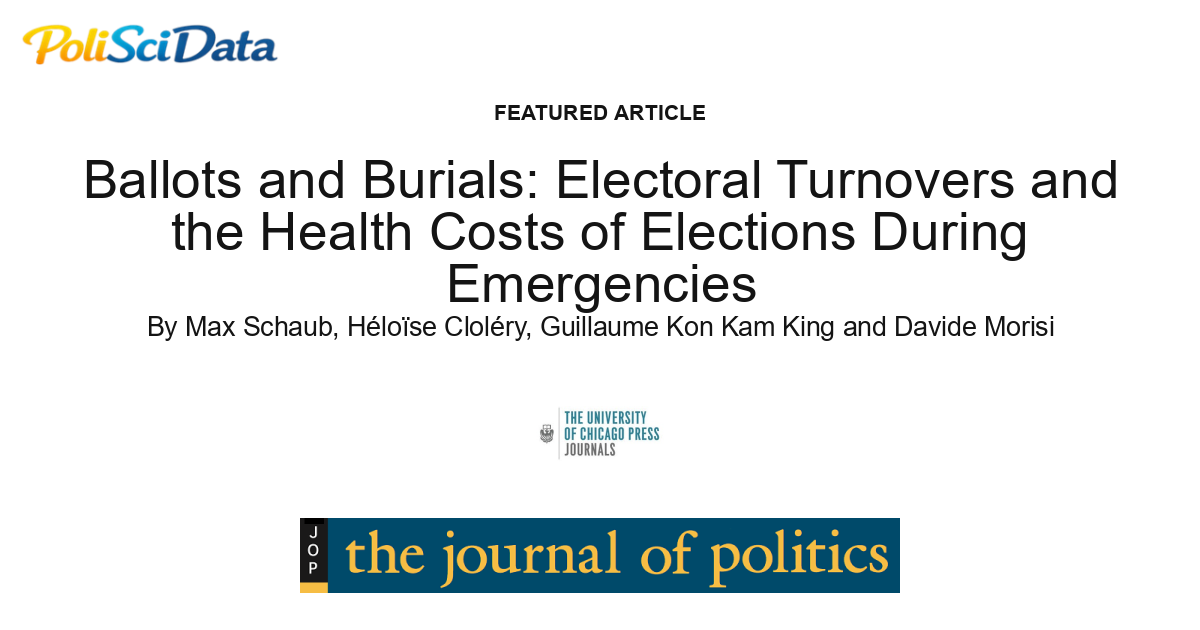
Article card for article: Ballots and Burials: Electoral Turnovers and the Health Costs of Elections During Emergencies
Ballots and Burials: Electoral Turnovers and the Health Costs of Elections During Emergencies was authored by Max Schaub, Héloïse Cloléry, Guillaume Kon Kam King and Davide Morisi. It was published by Chicago in JOP in 2025.
Find on Google Scholar
Find on University of Chicago Press
Journal of Politics

