📌 What This Research Shows
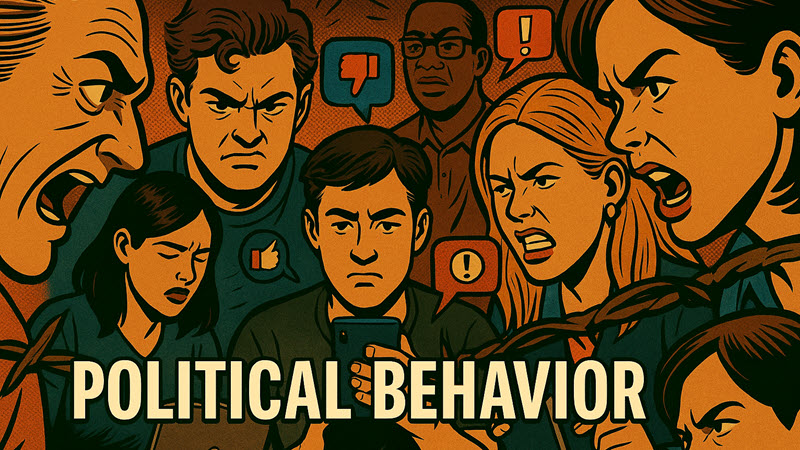
People who are averse to conflict tend to opt out when surveys or conversations are explicitly labeled 'political.' That selection creates a skew: contexts labeled as political end up disproportionately populated by people willing to engage in conflict, so political surveys and discussions give an inflated impression of contentiousness.
🔍 Evidence From Eight Studies
- Results come from eight studies that measured selection into surveys and discussions described as 'political.'
- Across these studies, conflict-averse individuals were more likely to decline participation or avoid discussion when the context was explicitly labeled 'political.'
🛠️ What Framing Helps — and What Doesn't
- Little evidence was found that emphasizing deliberative norms (e.g., asking for calm, reasoned discussion) reduces the selection effect.
- Conflict-averse respondents nevertheless showed greater willingness to discuss specific topics—economy, climate change, and racial inequality—when those topics were not framed as 'politics.'
- These respondents also reported more interest in politics when it was defined in terms of laws and policies and when debate or confrontation was deemphasized.
✨ Key Takeaways
- Labeling a context 'political' signals expected conflict and disproportionately attracts conflict seekers.
- The expected conflict therefore has a self-fulfilling effect: explicitly 'political' settings are more conflictual because conflict-averse people remove themselves from those settings.
- This selective participation implies that inferences from 'political' surveys and the impressions formed from explicitly political discussions will be systematically biased toward conflict.
💡 Why It Matters
These findings imply that how politics is labeled and framed shapes who participates and therefore how politics appears to the public and researchers. To get a more representative sense of public views and calmer exchanges, researchers and practitioners may need to rethink labels and frames that trigger conflict expectations.