FIND DATA: By Journal | Sites   ANALYZE DATA: Help with R | SPSS | Stata | Excel   WHAT'S NEW? US Politics | IR | Law & Courts🎡
   FIND DATA: By Journal | Sites   WHAT'S NEW? US Politics | IR | Law & Courts🎡
WHAT'S NEW? US Politics | IR | Law & Courts🎡
If this link is broken, please report as broken. You can also submit updates (will be reviewed).

Partisans Skip or Switch News When Coverage Turns Negative

Why This Study Matters

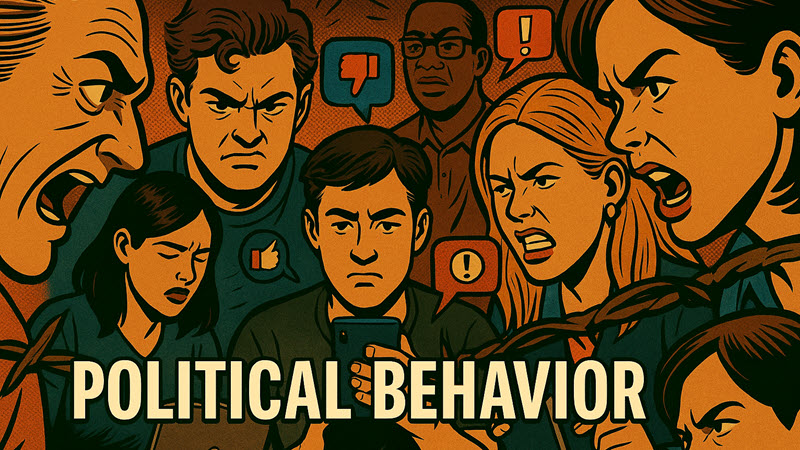
This study investigates whether partisans dynamically change their news consumption in response to negative coverage about their own party or the opposing partyβ€”a phenomenon labeled partisan temporal selective news avoidance. The analysis uses large-scale online behavior to capture real-world browsing adjustments to changing sentiment in the news environment.

🧾 Tracking 2,462 Americans for Nine Months

  • Browsing data cover nine months, totaling 27,648,770 visits from 2,462 U.S. users.
  • Visit-level content classifications are produced with machine learning to identify partisan targets and sentiment.

πŸ” What Was Measured and How

  • Macro-level: day-to-day changes in overall news sentiment about the in-party and out-party.
  • Micro-level: exposure, within a browsing session, to articles that are negative about the in- or out-party.
  • Outcomes tested include changes to:
  • overall news consumption volume,
  • visits to partisan outlets,
  • consumption of hard versus soft news,
  • attention to individual articles.

πŸ“ˆ Key Findings

  • Evidence supports partisan temporal selective news avoidance: partisans adjust how much, what type, and which sources of news they consume in response to changing news sentiment.
  • Macro-level analysis reveals partisan asymmetries in response to shifting daily sentiment about parties.
  • Micro-level exposure to negative articles about either party leads to shorter browsing sessions while simultaneously increasing visits to hard news and to additional negative-coverage articles for both Democrats and Republicans.

βš–οΈ Implications

These patterns show that dynamic, sentiment-driven avoidance and switching occur at both broad (daily) and sessional levels, shaping the informational environments that partisans encounter and with potential consequences for how citizens form political judgments and update partisan perceptions.
Article Card
Partisan Temporal Selective News Avoidance: Evidence from Online Trace Data was authored by Michael Heseltine, Hennes Barnehl and Magdalena Wojcieszak. It was published by Wiley in AJPS in 2025.
Find on Google Scholar
Find on JSTOR
Find on Wiley
American Journal of Political Science
data