🧪 What Was Tested
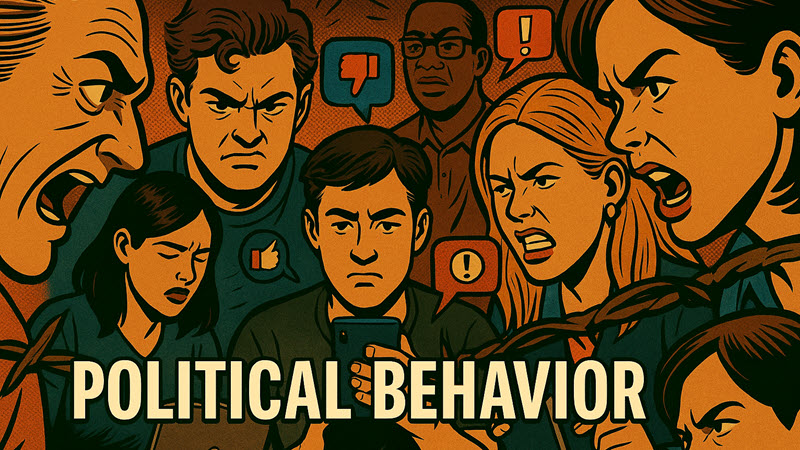
This study probes how political identification and ideology shape everyday social behavior. Behavioral games—dictator, trust, and public goods—were used to measure altruism, trust, and willingness to contribute to mutual benefits while varying the perceived party identity of interaction partners.
🔎 Key Findings
Partisan identifiers (those who say they identify with the Democratic or Republican Party) and ideological extremists (self-identified liberals or conservatives) show substantially stronger affective biases than politically unaffiliated individuals and ideological moderates.
📈 How This Fits With Other Work
Compared to prior behavioral studies, the results suggest rising levels of affective polarization in everyday social interactions—approaching the entrenched intergroup divisions more commonly associated with conflict or post-conflict societies.
💡 What This Implies and Possible Remedies
Findings indicate that partisan identity and ideology shape basic social preferences, not just political opinions. To reduce affective polarization, inter-group contact emerges as a promising mechanism for increasing interpersonal trust and bridging political divides.
⚖️ Why It Matters
These behavioral shifts in generosity, trust, and cooperative contribution have implications for social cohesion, cross-party collaboration, and the functioning of democratic institutions in the Trump era and beyond.
| Tribalism in America: Behavioral Experiments on Affective Polarization in the Trump Era was authored by Sam Whitt. It was published by Cambridge in JXPS in 2021. |