
📌 Why this matters
Misinformation undermines democratic governance, especially in developing countries with low average education, rapidly expanding Internet access, and widespread encrypted information sharing. A field experiment in India asked whether a short, in-person media literacy lesson could improve citizens' ability to spot false or misleading political claims during the 2019 elections.
📊 Field experiment during the 2019 elections
A randomized field trial enrolled 1,224 respondents around the 2019 Indian national election. Treated respondents received an hour-long, in-person media literacy training delivered by enumerators. The training was presented as a single, coherent learning module and its impact was measured by respondents' ability to identify misinformation in political stories.
🧭 What the training taught
🧾 Key findings
🔎 What this implies
The results indicate both the resilience of misinformation in the Indian context and the operation of motivated reasoning even within a historically less-ideological party system. Short, one-off pedagogical interventions may have limited effectiveness on average and can have perverse effects for partisans exposed to congenial misinformation, underscoring the need to account for partisan biases when designing counter-misinformation programs.
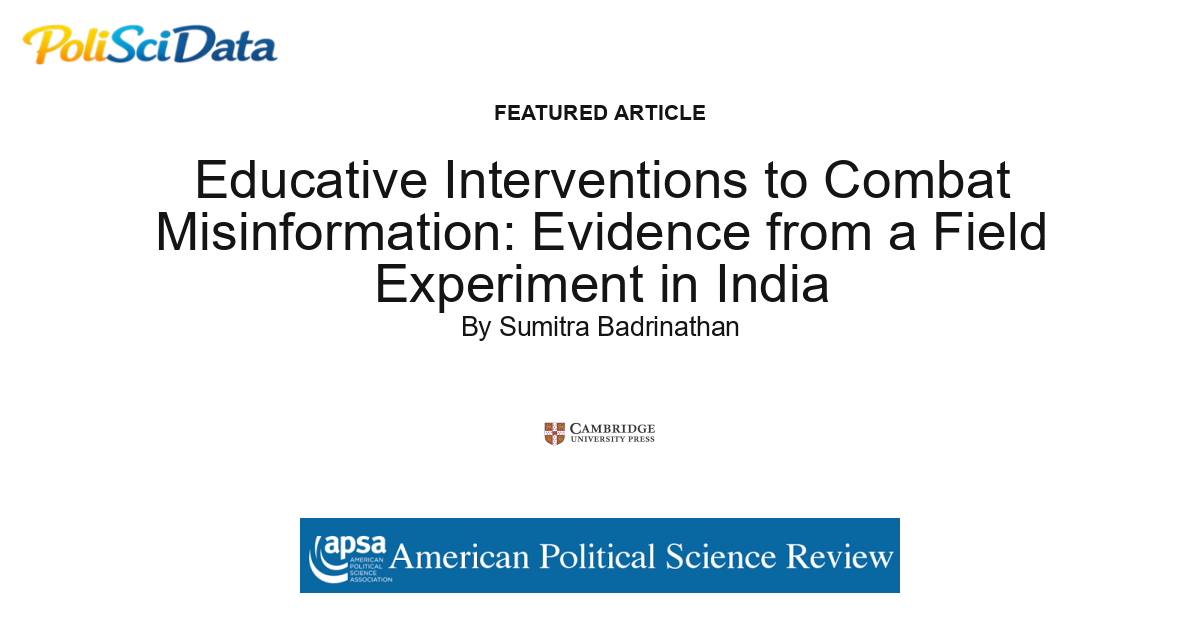
| Educative Interventions to Combat Misinformation: Evidence from a Field Experiment in India was authored by Sumitra Badrinathan. It was published by Cambridge in APSR in 2021. |


