Why Past Behavior Shapes Alliance Choices?
Mark J.C. Crescenzi, Jacob D. Kathman, Katja B. Kleinberg, and Reed M. Wood ask whether a state's past alliance behavior—its record of upholding agreements—affects the likelihood that other states will include it in future alliances. Understanding how reputation operates matters for theories of alliance formation and for policymakers trying to build durable security partnerships.
How the Authors Study It
The authors introduce a formal model of partner search in which governments weigh reputational information about potential allies alongside short-term strategic concerns. From that model they derive measurable indicators of “reputational alliance histories.” Empirically, they link those measures to data drawn from the ATOP (Alliance Treaty Obligations and Provisions) project and then use statistical tests to assess whether reputational signals predict entry into subsequent alliances.
Key Findings
Policy Implications
Reputational reliability appears to be an important asset in international coalition-building: a track record of honoring agreements raises a state's appeal as a partner. For scholars, the study highlights the value of integrating formal models of reputation with empirical measures from comprehensive alliance datasets such as ATOP.
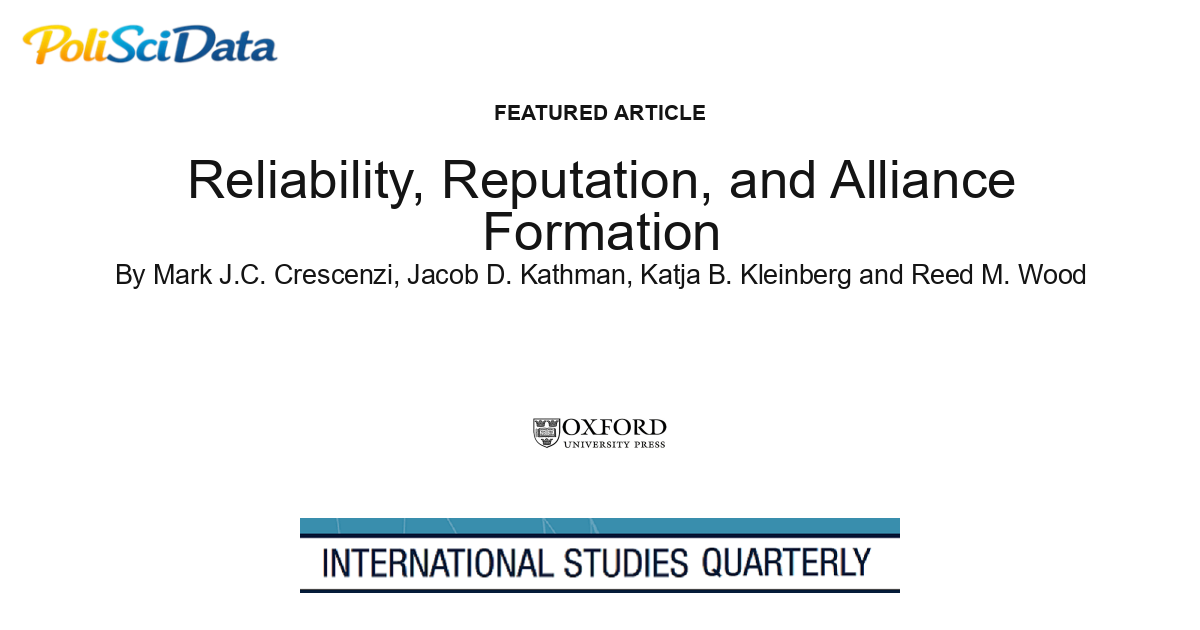
| Reliability, Reputation, and Alliance Formation was authored by Mark J.C. Crescenzi, Jacob D. Kathman, Katja B. Kleinberg and Reed M. Wood. It was published by Oxford in ISQ in 2012. |