
FIND DATA: By Journal | Sites   ANALYZE DATA: Help with R | SPSS | Stata | Excel   WHAT'S NEW? US Politics | IR | Law & Courts🎵
   FIND DATA: By Journal | Sites   WHAT'S NEW? US Politics | IR | Law & Courts🎵
WHAT'S NEW? US Politics | IR | Law & Courts🎵
If this link is broken, please
You can also
(will be reviewed).

Wealth Gap Widens, But Democracy Still Serves Middle Class?

Comparative Politics subfield banner

The widening wealth gap sparks debate over whether democratic governments are increasingly captured by the rich (Subversion of Democracy Model). This article examines two contrasting interpretations: one focusing on policy bias toward affluent interests, and another emphasizing how inequality affects political responsiveness.

• Key Findings: Direct analysis of public opinion data suggests redistributive policies remain strongly influenced by middle-class preferences despite rising inequality. Alternative interpretations challenge assumptions about the relationship between economic disparity and democratic governance.

• Methodology & Data

• Public Opinion Data: Examines policy preferences across income groups

• Macroeconomic Trends: Analyzes fiscal policy changes alongside wealth distribution shifts

• New Dataset: Provides evidence for a reinterpretation of democracy's response to inequality

The authors conclude that despite economic disparities, the democratic state continues to be driven by middle-class interests rather than being constrained by global capital.
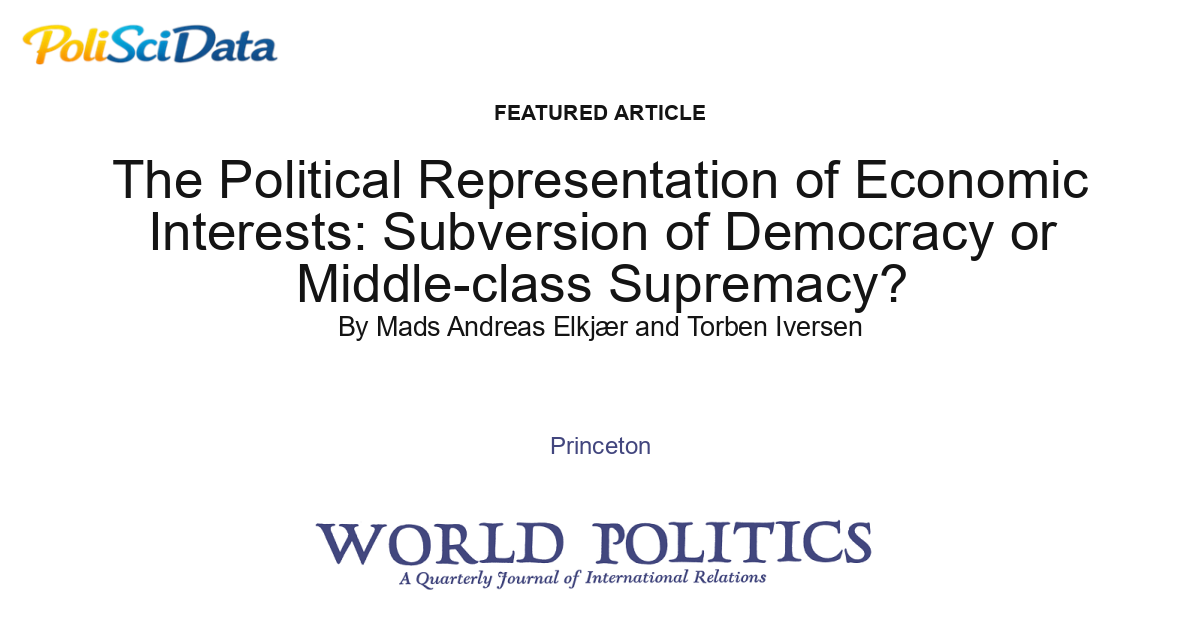
Article card for article: The Political Representation of Economic Interests: Subversion of Democracy or Middle-class Supremacy?
The Political Representation of Economic Interests: Subversion of Democracy or Middle-class Supremacy? was authored by Mads Andreas Elkjær and Torben Iversen. It was published by Princeton in World Pol. in 2020.
Find on Google Scholar
Princeton
World Politics

