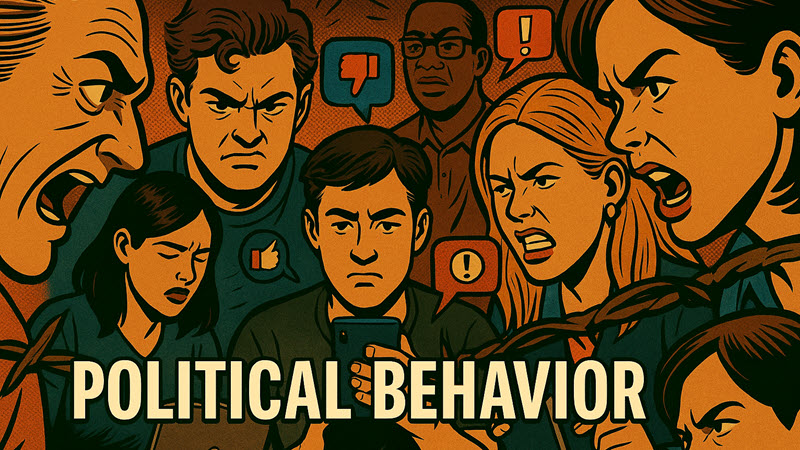
Legislators frequently blame other actors for legislative gridlock, potentially as a strategy to minimize personal reputational risks or bolster party standing. Through six survey experiments, this study finds that such blaming rhetoric undermines voters' evaluations of individual legislators who engage in it - particularly among out-partisans and independents. This negative effect on individual assessments seems counterintuitive given the potential partisan benefits.
Interestingly, while blaming others can enhance a party's relative electoral standing across all voter groups (including strong partisans), this comes at the cost of damaging other actors' reputations rather than directly benefiting one's own party position.
However, when examining immediate net effects on individual legislators themselves, the study concludes that their blame-claiming does not yield significant electoral benefits. This suggests a complex dynamic where while parties may strategically blame opponents to improve relative standing without direct voter backlash against specific actors, coordinated partisan blaming has limited impact on electability.
| The Effects of Blaming Others for Legislative Inaction on Individual and Collective Evaluations was authored by David Doherty and Laurel Harbridge-Yong. It was published by Wiley in LSQ in 2020. |