FIND DATA: By Journal | Sites   ANALYZE DATA: Help with R | SPSS | Stata | Excel   WHAT'S NEW? US Politics | IR | Law & Courts🎵
   FIND DATA: By Journal | Sites   WHAT'S NEW? US Politics | IR | Law & Courts🎵
WHAT'S NEW? US Politics | IR | Law & Courts🎵
If this link is broken, please
You can also
(will be reviewed).

Consensus Beats Partisanship? New Data Questions Science Correction Strategies

Framingmisinformation correctionconsensus messagingPolitical Behavior@R&P1 Stata file1 datasetDataverse
Political Behavior subfield banner

The COVID-19 pandemic brought widespread attention to correcting health-related misperceptions. This research examines how effective corrections are when combined with scientific consensus messages or partisan viewpoints. A survey experiment was conducted using field experiments across three topics: COVID-19 threat, climate change threat, and vaccine efficacy.

Key Findings:

* Consensus corrections proved no more effective than standard ones overall.

* Only one specific misperception saw improvement with a consensus correction.

* Partisan alignment did not boost the effectiveness of consensus messages; partisan opposition actually reduced credibility and potentially triggered backfire effects.

These results challenge the common assumption that citing scientific agreement enhances corrective messaging. They suggest standard corrections may be more reliable than previously thought, especially when framed against misinformation.
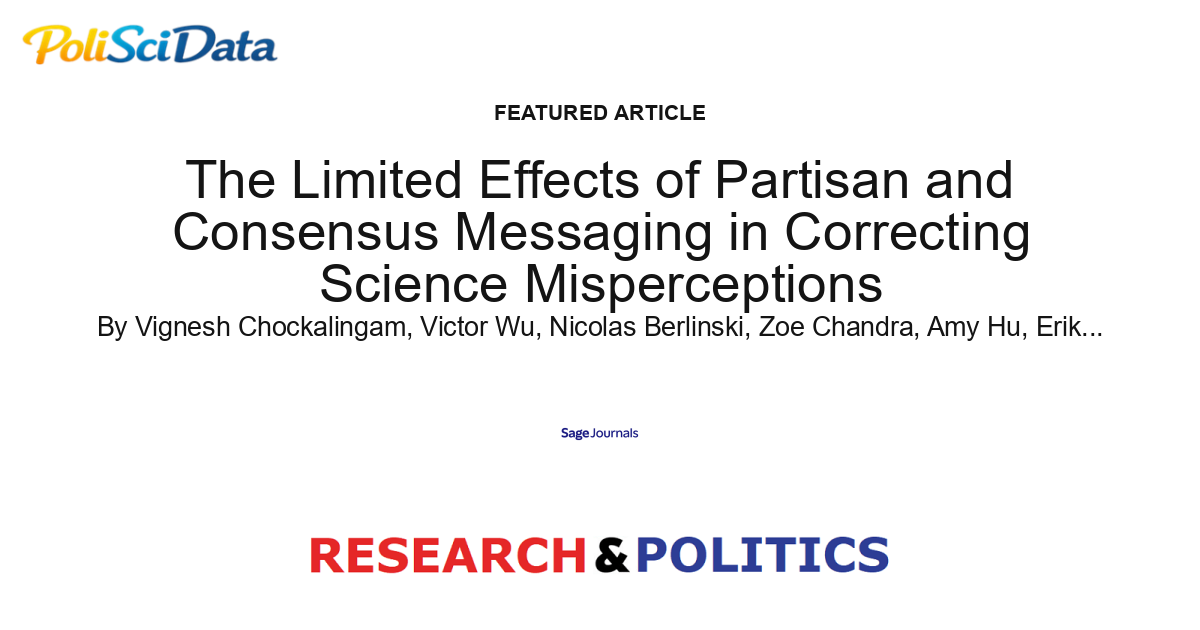
Article card for article: The Limited Effects of Partisan and Consensus Messaging in Correcting Science Misperceptions
The Limited Effects of Partisan and Consensus Messaging in Correcting Science Misperceptions was authored by Vignesh Chockalingam, Victor Wu, Nicolas Berlinski, Zoe Chandra, Amy Hu, Erik Jones, Justin Kramer, Xiaoqiu Steven Li, Thomas Monfre and Yong Sheng Ng. It was published by Sage in R&P in 2021.
Find on Google Scholar
Find on Sage Journals
Research & Politics