
A June 2019 national survey asks how Americans view the relationship between civilian leaders and the military. The authors find two main takeaways: respondents are unusually deferential to the military on when force should be used and comfortable with high-ranking officers intervening in public policy debates; and opinions about civil–military relations are shaped by partisan alignment, with Republicans less deferential and Democrats more willing to see the military as a check when their party opposes the president.
Methods
The study analyzes results from a June 2019 survey to probe public views of democratic civil–military relations and how those views vary by partisanship. The abstract frames the analysis as addressing gaps in existing polling that typically measures trust in the military but not deeper attitudes about civilian control.
Findings and cautions
According to the abstract, Americans in this survey do not accept the basic premises of democratic civil–military relations: they grant the military strong authority over decisions to use force and accept military intervention in public debates. The authors also report that partisan dynamics shape these views, producing patterns that depend on which party holds the presidency in June 2019. The abstract emphasizes normative stakes by noting that democracy is weakened if civilians relinquish their “right to be wrong.”
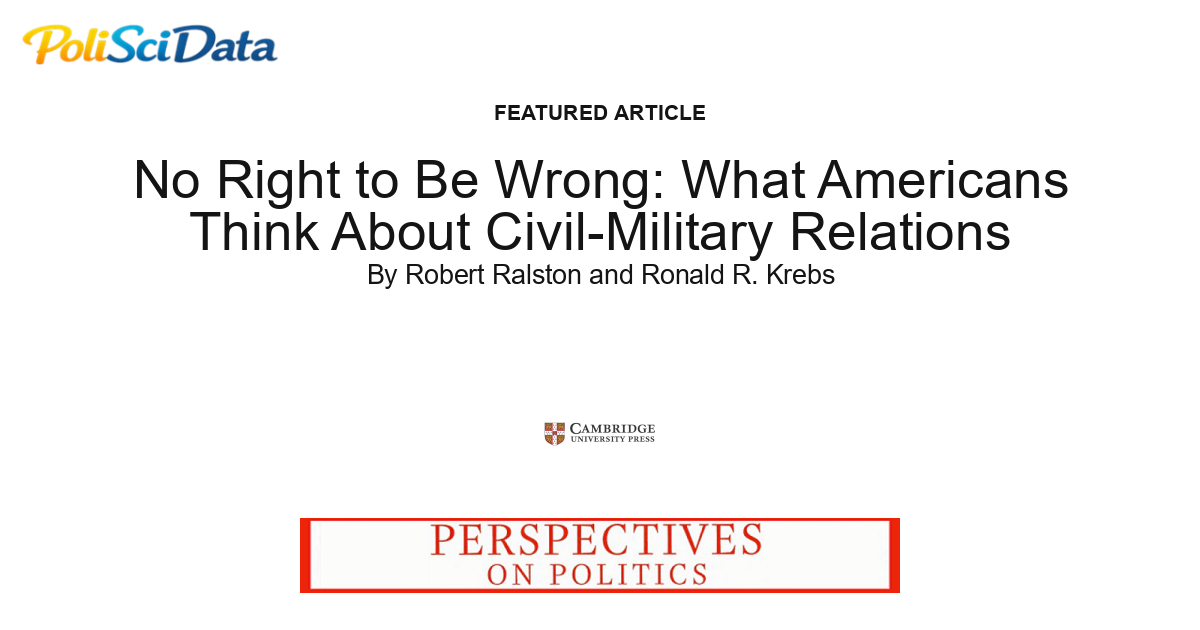
| No Right to Be Wrong: What Americans Think About Civil-Military Relations was authored by Robert Ralston and Ronald R. Krebs. It was published by Cambridge in POP in 2023. |


