FIND DATA: By Journal | Sites   ANALYZE DATA: Help with R | SPSS | Stata | Excel   WHAT'S NEW? US Politics | IR | Law & Courts🎵
   FIND DATA: By Journal | Sites   WHAT'S NEW? US Politics | IR | Law & Courts🎵
WHAT'S NEW? US Politics | IR | Law & Courts🎵
If this link is broken, please
You can also
(will be reviewed).

Inequality Intensifies Right-Wing Shift in Welfare Policy: A Counterintuitive Look at Party Platforms

Comparative Politics subfield banner

This study examines how rising inequality affects welfare generosity. It introduces the Political Reinforcement hypothesis, which suggests that growing economic disparity actually strengthens rather than modifies political polarization on welfare issues.

The research models political party platforms by analyzing two key factors:

  • The ideology and opportunism of party members
  • Voter interests based on income distribution patterns

Based on the assumption that welfare spending is a normal good within each income class, policy changes occur when inequality increases. This leads to:

  1. A majority of voters shifting rightward economically.
  2. The left-leaning parties strengthening their platforms' conservative stance against welfare generosity.

The findings are based on analyzing welfare policy positions from political parties across all 22 OECD countries.
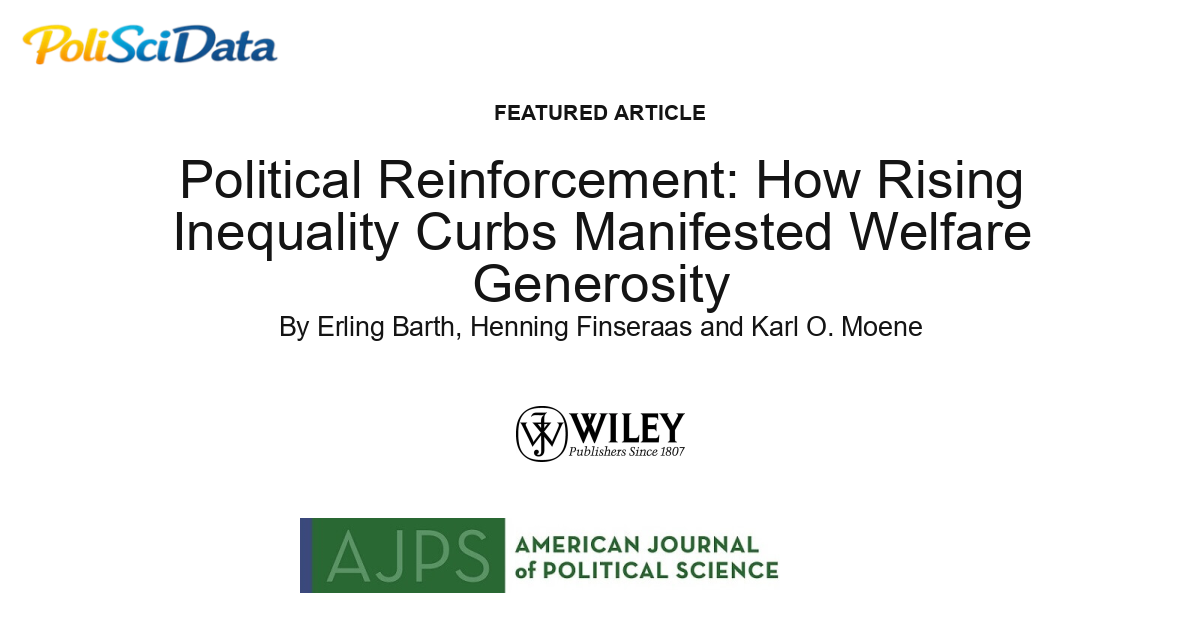
Article card for article: Political Reinforcement: How Rising Inequality Curbs Manifested Welfare Generosity
Political Reinforcement: How Rising Inequality Curbs Manifested Welfare Generosity was authored by Erling Barth, Henning Finseraas and Karl O. Moene. It was published by Wiley in AJPS in 2015.
Find on Google Scholar
Find on Wiley
American Journal of Political Science