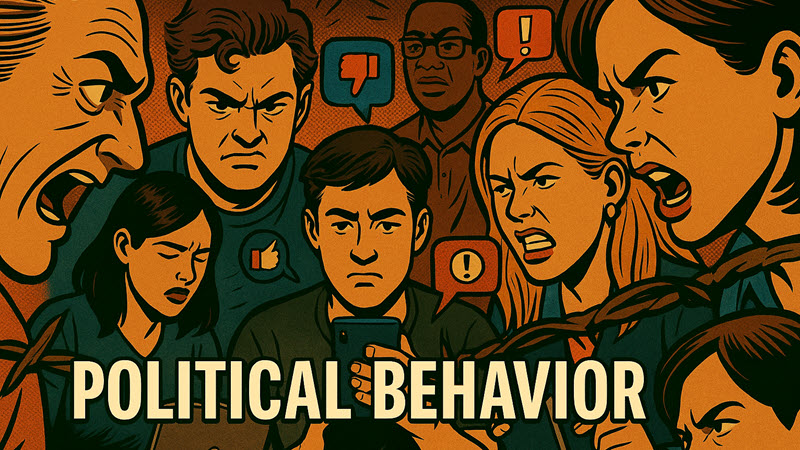
Citizens rely on party cues to navigate complex political information, but when elected officials deviate from the party line, these shortcuts can backfire. Using data from the 2006 Cooperative Congressional Election Study (CCES), this analysis examines voter knowledge about their senators' policy positions across seven high-profile roll-call votes. Results reveal a counterintuitive pattern: politically interested citizens are most knowledgeable when their senator aligns with party—but also become the most misinformed segment of the public when the senator deviates, demonstrating a significant drawback to heuristic use in political settings.
Data & Methods: Analysis utilizes survey responses from the 2006 Cooperative Congressional Election Study (CCES).
This research reveals that citizens' reliance on party-based shortcuts creates significant misalignment between voter knowledge and actual policy. Understanding this dynamic is crucial for designing effective political communication strategies, evaluating media influence, and assessing the broader implications of partisan cues in representative democracies.
| Heuristics Behaving Badly: Party Cues and Voter Knowledge was authored by Logan Dancey and Geoffrey Sheagley. It was published by Wiley in AJPS in 2013. |