FIND DATA: By Journal | Sites   ANALYZE DATA: Help with R | SPSS | Stata | Excel   WHAT'S NEW? US Politics | IR | Law & Courts🎵
   FIND DATA: By Journal | Sites   WHAT'S NEW? US Politics | IR | Law & Courts🎵
WHAT'S NEW? US Politics | IR | Law & Courts🎵
If this link is broken, please report as broken. You can also submit updates (will be reviewed).

Civil Rights Roll Calls Reveal Less Polarized Conflict Than Perceived

PolarizationUS HouseCivil RightsRoll Call VotingAmerican PoliticsAJPS7 R files7 Stata files25 datasetsDataverse

This article examines elite conflict on civil rights roll calls in the U.S. House from 1877 to 2011.

The study addresses challenges in comparing political polarization over time using traditional methods, pointing out that current measures often fail to consider policies and historical context.

Our approach incorporates policy details about civil rights votes during this period.

Key Findings:

* Elite disagreement on the persistent issue of civil rights is less extreme than commonly assumed.

* Polarization occurs in a narrower part of overall voting activity (civil rights roll calls).

* Using historical data shows significant differences from contemporary polarization patterns.

Why It Matters:

Roll call analysis reveals that perceived high polarization may overlook nuanced, iterative policymaking processes across long periods. This refined perspective offers clearer insights for comparing political conflict historically and improves understanding of legislative dynamics over time.
Article Card
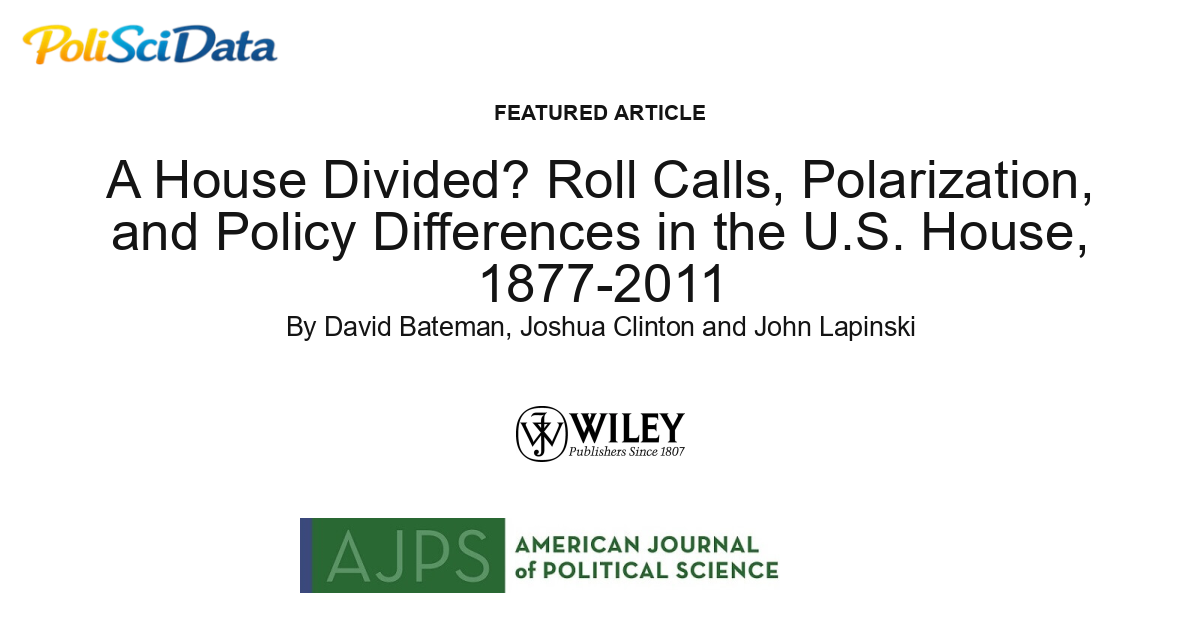
A House Divided? Roll Calls, Polarization, and Policy Differences in the U.S. House, 1877-2011 was authored by David Bateman, Joshua Clinton and John Lapinski. It was published by Wiley in AJPS in 2017.
Find on Google Scholar
Find on JSTOR
Find on Wiley
American Journal of Political Science
data