FIND DATA: By Journal | Sites   ANALYZE DATA: Help with R | SPSS | Stata | Excel   WHAT'S NEW? US Politics | IR | Law & Courts🎵
   FIND DATA: By Journal | Sites   WHAT'S NEW? US Politics | IR | Law & Courts🎵
WHAT'S NEW? US Politics | IR | Law & Courts🎵
If this link is broken, please
You can also
(will be reviewed).

Disgust vs Anxiety: Why Emotions Shape Responses to Health Threats

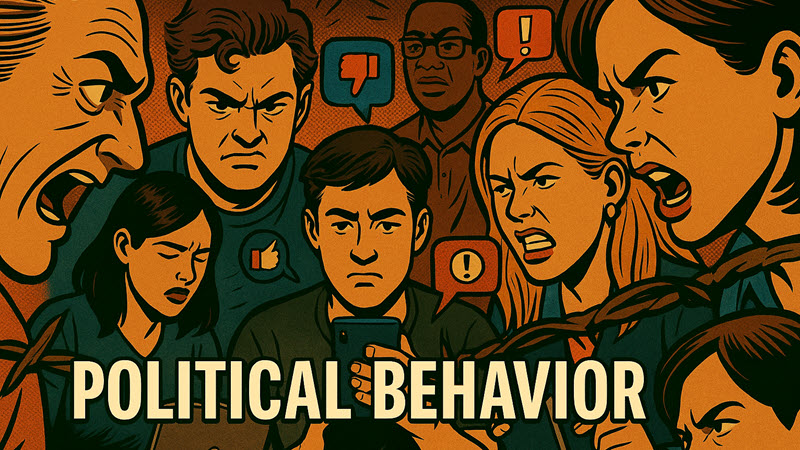
Political Behavior subfield banner

This study explores how disgust and anxiety influence learning during political threats.

• Context: Research on emotions in political engagement often focuses solely on anxiety, neglecting the distinct role of disgust.

• Methodology: Experiments manipulated perceptions of infectious disease outbreaks to measure emotional responses.

• Findings: Disgust led people to avoid crucial information and additional resources about a threat.

• Implications: These results highlight how basic emotions like disgust can reduce engagement precisely when they are most relevant or necessary for effective response.

The research reveals that while both emotions react naturally to threats, disgust operates differently from anxiety in terms of political learning. By creating conditions mimicking infectious disease outbreaks, the experiments demonstrate that disgust—a fundamental emotion guiding avoidance of contamination—impairs information processing during critical situations unlike its counterpart anxiety does.
Article card for article: Disgust, Anxiety, and Political Learning in the Face of Threat
Disgust, Anxiety, and Political Learning in the Face of Threat was authored by Scott Clifford and Jennifer Jerit. It was published by Wiley in AJPS in 2018.
Find on Google Scholar
Find on Wiley
American Journal of Political Science