FIND DATA: By Journal | Sites   ANALYZE DATA: Help with R | SPSS | Stata | Excel   WHAT'S NEW? US Politics | IR | Law & Courts🎵
   FIND DATA: By Journal | Sites   WHAT'S NEW? US Politics | IR | Law & Courts🎵
WHAT'S NEW? US Politics | IR | Law & Courts🎵
If this link is broken, please
You can also
(will be reviewed).

Congress May Be More Powerful Than You Think

Spatial Modelscongressional vetofederal regulationspresidential endorsementAmerican Politics@AJPS3 R files8 datasetsDataverse
American Politics subfield banner

Existing studies may have underestimated presidential unilateral power. This article shows Congress consistently exerts veto power over federal regulations, even when the president endorses them.

### Data & Methods

The research tests two models: one assuming Congress can execute a legislative veto; another requiring presidential coalitions for congressional influence.

#### Key Findings

Applying empirical tests reveals consistent evidence of Congressional veto power. This holds true even over actions the President endorses.*

### Why It Matters

This finding challenges conventional understanding by demonstrating:

* The limitations on presidential unilateral power are more significant than previously acknowledged.

* Congressional influence extends beyond statutory constraints.

The article concludes that this evidence suggests existing studies may significantly understate constraints on presidential power.
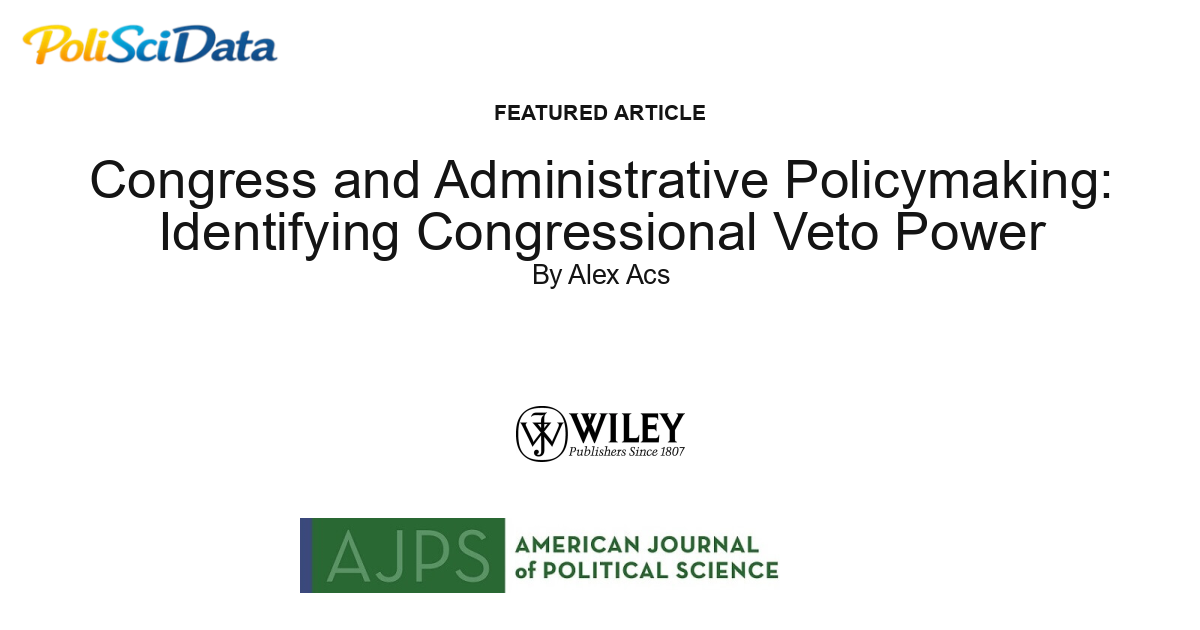
Article card for article: Congress and Administrative Policymaking: Identifying Congressional Veto Power
Congress and Administrative Policymaking: Identifying Congressional Veto Power was authored by Alex Acs. It was published by Wiley in AJPS in 2019.
Find on Google Scholar
Find on Wiley
American Journal of Political Science