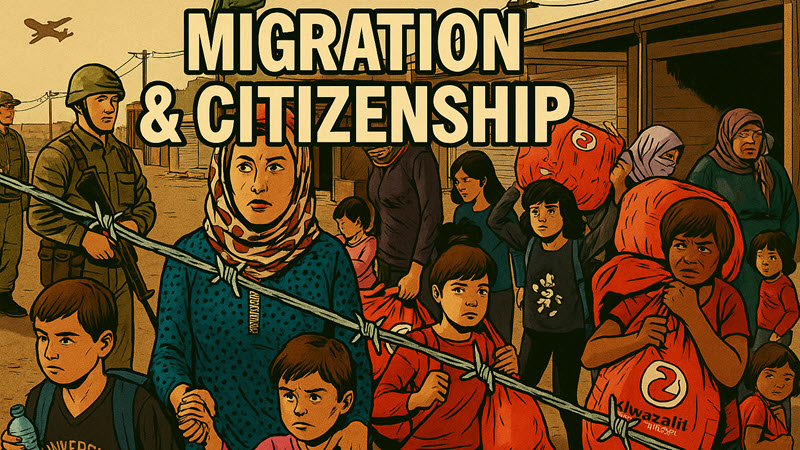
This study asks who helps refugees and which refugee profiles attract more aid by distinguishing stable dispositional empathy from experimentally induced situational empathy. Using a representative face-to-face survey in Poland, the authors combine an activation (perspective-taking) treatment with a conjoint experiment to compare responses to refugees from Syria and Ukraine and to link empathy measures to self-reported and behavioral helping.
Representative face-to-face survey (N = 2,500) Conjoint experiment comparing need and economic potential Dispositional empathy strongly predicts helping
Data and methods
The analysis relies on a nationally representative face-to-face survey in Poland (N = 2,500). The design includes a perspective-taking manipulation intended to activate situational empathy and a conjoint experiment that varied refugee attributes (e.g., indicators of humanitarian need versus economic potential). The authors measure both dispositional empathy (a stable trait) and situational empathy (treatment-induced), and combine attitudinal and behavioral measures of assistance.
Main findings
The authors report that dispositional empathy — a stable capacity to understand and share others’ emotions — is strongly associated with helping behavior. By contrast, the perspective-taking treatment intended to induce situational empathy produced no detectable effect. The conjoint results indicate respondents prioritize refugees in greater humanitarian need over those with higher economic potential, and that people high in dispositional empathy are especially responsive to vulnerability cues.
- The situational (perspective-taking) manipulation had no effect on helping.
- Dispositional empathy predicts both attitudinal and behavioral measures of assistance, and increases sensitivity to vulnerability in the conjoint.