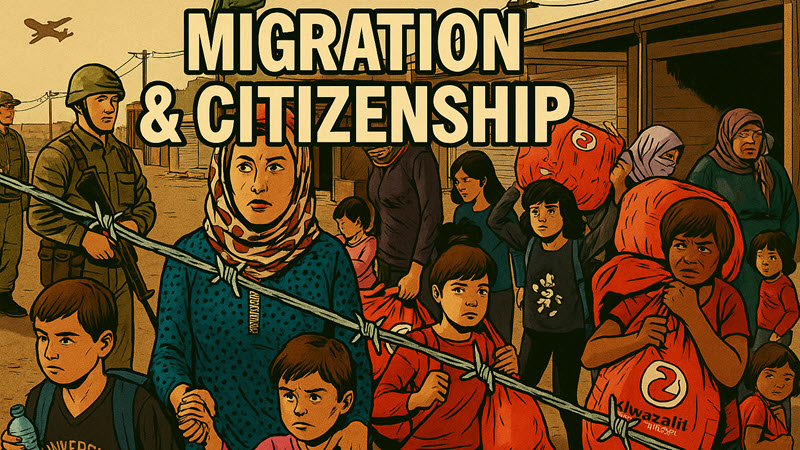
What leads some communities to be displaced before violence reaches them? This study probes whether social cohesion—by enabling collective action—raises the likelihood that whole communities undertake “preemptive evacuation” ahead of belligerent operations. Using detailed archival Village Files to build a village-level dataset about Arab Palestinian communities during the 1948 Arab–Israeli War, the authors assess variation in social cohesion alongside other social, political, and economic village characteristics to evaluate links between cohesion, migration, and casualties.
Key measurement: social cohesion Dataset: village-level Village Files Case: 1948 Arab–Israeli War
Data and methods
The study constructs a village-level dataset drawn from the previously restricted Village Files and uses those records to measure social cohesion and other village attributes; the abstract characterizes the project as an investigation of Arab Palestinian villages in the 1948 war. The abstract does not report detailed statistical models or identification strategies; it highlights archival reconstruction of community-level covariates as the empirical foundation.
Main findings
The authors report that social cohesion facilitates collective migration and that communities lacking cohesion may suffer higher casualties from targeted violence. The abstract frames this as suggestive evidence and emphasizes the plausibility probe rather than definitive causal claims.
- The analysis centers on “preemptive evacuation” as a form of conflict-related displacement.
- Findings point to a relationship between weaker social cohesion and greater casualties in targeted-violence settings.