If this link is broken, please You can also (will be reviewed).
How Ideology Fuels Affective Polarization
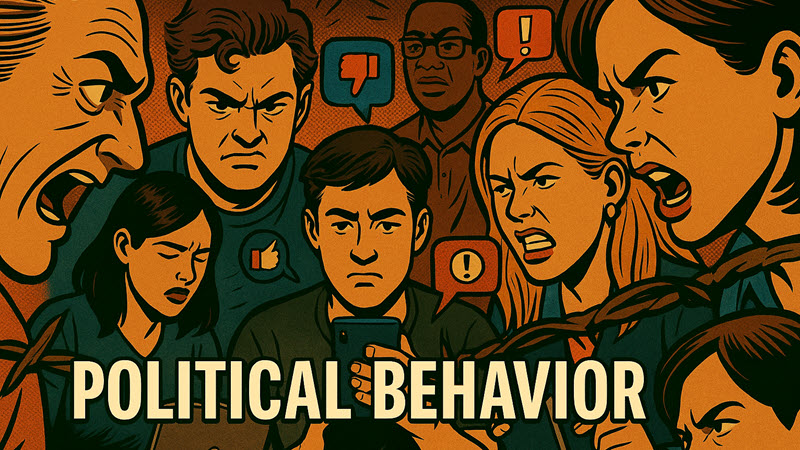
Article Abstract:
Scholars have reached mixed conclusions about the implications of increased political polarization for citizen decision-making. In this paper, we argue that citizens respond to ideological divergence with heightened affective polarization. Using a survey experiment conducted with a nationally representative sample of U.S. citizens, we find that increased ideological differences between political figures produce increasingly polarized affective evaluations, and that these differences are especially large among respondents with stronger ideological commitments and higher levels of political interest. We provide further support for these findings in an observational study of citizens’ evaluations of the U.S. Senators from their state. We also find that the polarizing effects of ideological differences can be largely mitigated with biographical information about the public officials, which suggests that the pernicious consequences of ideological polarization can be overcome by focusing on matters other than political disagreement.
| How Ideology Fuels Affective Polarization was authored by Jon Rogowski and Joseph Sutherland. It was published by Springer in Pol. Behav. in 2016. |