
The one-person-one-vote doctrine solved a real constitutional problem. Before Baker v. Carr, Reynolds v. Sims, and related cases, many states used systems that systematically overrepresented rural counties and underrepresented fast-growing urban areas. The problem was not simply population variation. It was entrenched political inequality: some communities gained legislative power because district lines or county-unit systems failed to respond to population change. The Supreme Court made those arrangements justiciable in Baker v. Carr, 369 U.S. 186 (1962), and then required state legislative districts to be substantially equal in population in Reynolds v. Sims, 377 U.S. 533 (1964).
The doctrine, however, created a different problem. Modern redistricting pursues population equality by repeatedly dividing counties, cities, neighborhoods, and other recognizable political communities into artificial districts. Those districts usually have no independent institutional reality. They are not school districts, counties, cities, service areas, or communities that residents can identify on the ground. They are temporary legal constructions, redrawn every decade and often manipulated for partisan or incumbent-protection purposes.
The puzzle is therefore not whether equality matters. It plainly does. The question is whether exact district-population equality is the only way to protect equal representation. Congressional apportionment suggests another model. Seats in the House are apportioned among states in a way that minimizes population inequality, but it does not eliminate it. Each state receives a whole number of representatives, and the resulting districts across states are not perfectly equal in population. That system is still treated as a valid method of population-based representation because it allocates whole seats among real political units under a principled apportionment rule.
This article explores whether a similar principle could be applied within states. Instead of treating every legislative district as a free-floating map unit, a state could allocate seats to counties, cities, or combinations of local political subdivisions using an apportionment method. The goal would be to preserve local political units while minimizing representational inequality.
How Federal Apportionment Works and What It Suggests for States
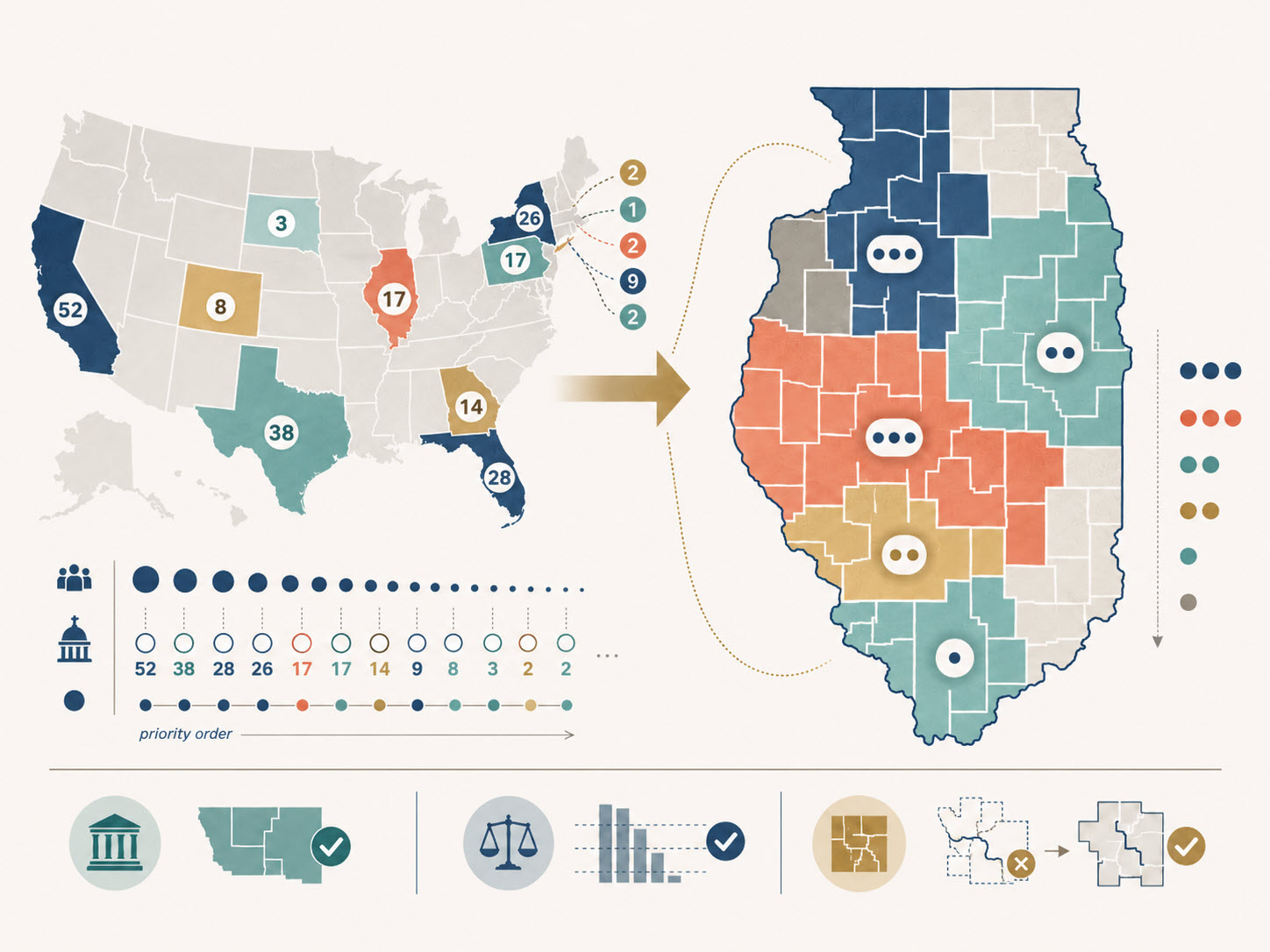
The federal system already accepts a tradeoff between numerical equality and political-unit integrity. House seats are apportioned to states, not drawn from a single national pool of equally sized districts. Because seats are whole units and states are fixed political entities, population equality across states cannot be exact. Federal law supplies the basic framework. Under 13 U.S.C. § 141, the census produces the state population tabulation used for apportionment, and under 2 U.S.C. § 2a the President transmits to Congress the apportionment of the existing 435 seats by the method of equal proportions, with each state receiving at least one seat. The remaining seats are distributed one at a time according to priority values derived from each state’s population and its current number of seats. In simplified terms, after every state receives one seat, each possible next seat is ranked by a priority number based on the state’s population divided by the geometric mean of its current and next possible seat totals. Seats are then assigned in descending order of those priority values until all 435 seats are distributed. The practical effect is to allocate representation in a way that minimizes, but does not eliminate, population variation among states’ congressional districts. The system is population-based, but it does not require every district in the nation to contain exactly the same number of people.
That federal structure contains the seed of a redistricting alternative. A state could adopt a parallel approach within its own legislative system. Instead of assuming that equal representation requires the construction of artificial districts with nearly identical populations, the state could allocate seats to counties, cities, or combinations of local political subdivisions using an apportionment method. The state-level steps would look broadly similar to the federal process:
- Determine the total number of seats in the legislative chamber.
- Calculate the population baseline for a seat.
- Identify the political subdivisions that are large enough to qualify for one or more seats on their own.
- Allocate whole seats to those subdivisions using a neutral apportionment rule.
- Assign additional seats according to a transparent remainder or priority formula.
- Assign smaller subdivisions to shared districts with neighboring subdivisions where necessary.
- Avoid splitting political subdivisions unless a subdivision is large enough to support multiple seats or the state has already created recognized internal subunits.
- As a final check, test whether transferring a seat from one political subdivision or district grouping to another would improve the overall apportionment; if not, the allocation has reached the same kind of local optimum that the federal method seeks to achieve.
This system would not eliminate population variation among districts. It would instead manage that variation through a rule designed to minimize inequality while preserving political subdivisions. That is the same basic logic that federal apportionment applies to states. The point is not to recreate the old county-unit systems that Baker and Reynolds helped dismantle. Those systems entrenched rural overrepresentation and deprived growing urban populations of equal political power. The proposed approach would do the opposite: it would allocate seats to political subdivisions in proportion to population, using a transparent apportionment method. The relevant unit would be the county, city, or combination of subdivisions, but the governing principle would remain population-based representation.
The design choices would still matter. One version could use counties as the primary unit. Another could allow sufficiently large cities to receive seats directly, with their populations subtracted from surrounding county totals. A third could allow counties and cities to choose or recommend neighboring subdivisions for inclusion in shared districts, subject to state-law constraints and judicial review. In all versions, the aim would be to reduce artificial line-drawing by shifting from district construction to seat allocation.
Why This Is Not the Old County-Unit System
The obvious objection is that this sounds like the pre-Reynolds county-unit arrangements that distorted representation. That objection has to be taken seriously. The proposed system would be constitutionally and normatively unacceptable if it gave each county one representative regardless of population. That was the problem: political units were represented as units without adequate regard to population.
The apportionment model is different. It would treat political subdivisions as units for line-drawing purposes, but it would allocate representation according to population. A large urban county would receive many seats. A small rural county might receive no independent seat and would need to be combined with neighboring areas. The system would therefore preserve population as the basis of representation while reducing arbitrary boundary manipulation.
The federal analogy helps clarify the distinction. The House does not give each state equal representation; the Senate does that. The House apportions representation among states by population, subject to whole-seat constraints. An intrastate apportionment model would follow the House principle, not the Senate principle. It would not make counties equal. It would make counties and cities the geographic containers through which population-based representation is allocated.
Georgia as an Illustration
Georgia illustrates both the promise and difficulty of the idea. The Georgia House has 180 seats. With a state population a little over 10.4 million, the rough ideal district size is about 58,000 people. Georgia also has 159 counties, many of which are far smaller than the ideal district size. Taliaferro County, for example, is dramatically too small to receive a seat on its own under any realistic population-based system.
That means a pure county-preservation system would not work if every county had to receive at least one representative. To make the smallest county large enough for an individual seat would require thousands of representatives, which is administratively unrealistic. But the point of the proposed model is not to give every county a seat. It is to allocate seats to political subdivisions and combinations of political subdivisions in a way that preserves boundaries where feasible.
Under a county-based model, Georgia’s largest counties would receive multiple seats. Fulton County might receive roughly seventeen seats; Gwinnett about fifteen; Cobb and DeKalb about thirteen each. Many mid-sized counties would receive one or more seats. Smaller counties would be grouped into districts. If cities were treated as separate apportionment units, Atlanta, Columbus, Augusta, Macon, Savannah, Athens, and other sufficiently large municipalities could receive seats directly, with their populations accounted for separately from surrounding county populations.
This example shows why the idea requires design work. Cities may cross county boundaries. Counties contain cities. Some political communities are municipal, while others are county-based or regional. But that is not a defect of the proposal. It identifies the institutional choice the state should have to make openly: which political subdivisions matter for representation, and how should their populations be translated into whole seats?
Advantages of the Model
The apportionment approach has several potential advantages over conventional district-drawing.
First, it could reduce boundary manipulation. If seats are allocated to existing political subdivisions or combinations of subdivisions, mapmakers have less freedom to carve voters into artificial configurations. Partisan gerrymandering, incumbent protection, and community fragmentation would not disappear, but they would operate within narrower constraints.
Second, it could make representation more intelligible. Citizens know whether they live in Atlanta, DeKalb County, Marietta, or rural north Georgia. They are less likely to understand why they are in a particular numbered legislative district whose borders shift every decade. Representation through recognized political units may strengthen democratic accountability.
Third, it could protect local community integrity without reviving rural overrepresentation. The key is proportional allocation. Large urban areas would receive representation proportionate to population. Small rural areas would be combined where necessary. No county or city would receive special political weight simply because it is a county or city.
Fourth, it might reduce the instability of district identity. Current districts are often temporary. Representatives, voters, and communities are shuffled after every census. A political-subdivision apportionment model would still require adjustment, but the basic units would be more stable.
Fifth, it could improve empirical evaluation of representation. Instead of measuring only compactness, partisan bias, or population deviation, scholars could measure how often districts split counties, cities, school districts, media markets, commuting zones, or other civic units. The central empirical question would be whether representation organized around political subdivisions produces more understandable and less manipulable electoral structures.
Likely Objections
The first objection is constitutional. Modern one-person-one-vote doctrine, especially for congressional districts, demands very tight population equality. Wesberry v. Sanders, 376 U.S. 1 (1964), held that congressional districts within a state must be as nearly equal in population as practicable. State legislative districts receive somewhat more flexibility, but Reynolds still requires substantial equality. A state that adopted an apportionment model with meaningful population deviations would therefore face serious constitutional challenge.
The response is not that current doctrine plainly allows the proposal. It probably does not, at least in strong form. The response is that the doctrine should be reconsidered or modified to recognize a different equality-preserving mechanism: apportionment among real political subdivisions according to population. The argument is reformist, not merely interpretive.
The second objection is that political subdivisions are themselves imperfect proxies for community. Counties and cities may be arbitrary, unequal, racially segregated, or historically contingent. Some cities are fragmented suburbs; some counties contain multiple distinct communities. This is true. But current districts are also artificial and manipulable. The relevant question is comparative: whether existing political subdivisions, despite imperfections, provide a more stable and democratically meaningful foundation than districts drawn from scratch.
The third objection is that minority-representation law may constrain the proposal, especially if a state-level apportionment system relies on multimember districts or on preserving county and city boundaries in ways that reduce opportunities for minority voters to elect preferred candidates. That issue has become more complicated in recent Supreme Court cases. In Allen v. Milligan (2023), the Court reaffirmed the existing Gingles framework and upheld a Section 2 challenge requiring Alabama to create a second district in which Black voters had an opportunity to elect their preferred candidate. But the Court’s later decisions have narrowed or complicated the legal environment in other ways. In Alexander v. South Carolina State Conference of the NAACP (2024), the Court emphasized the difficulty of disentangling race from politics and reversed a racial-gerrymandering ruling against South Carolina’s congressional map. And in Louisiana v. Callais (2026), the Court updated the Section 2 framework, stressed constitutional limits on race-driven districting, and made it harder to treat race-conscious district creation as the routine remedial answer.
Those developments matter for this proposal in two directions. On the one hand, they may modestly reduce the pressure to split counties and cities solely to construct additional majority-minority districts, especially where race-predominant line drawing would itself raise constitutional concerns. On the other hand, they do not eliminate Voting Rights Act constraints. Any apportionment-based system would still need to account for racially polarized voting, minority electoral opportunity, and the possibility that multimember or subdivision-based arrangements could dilute minority voting strength. The implication is not that the proposed model is newly easy to implement. It is that the legal question would have to be framed in a post-Milligan, post-Alexander, and post-Callais world, where courts remain attentive both to minority vote dilution and to the constitutional costs of aggressive race-based district design.
The fourth objection is that no apportionment method is neutral in every case. Remainder rules matter. Thresholds matter. Choices about whether cities or counties receive priority matter. But the same is true of all redistricting. The advantage of an apportionment system is that these choices can be made through transparent general rules rather than through thousands of discretionary boundary decisions.
Research Design
The project could develop as a legal-institutional essay, an empirical paper, or a simulation.
The legal essay would argue that one-person-one-vote doctrine should distinguish between two forms of equality: equality through exact district population and equality through population-based apportionment among political units. It would not deny the constitutional wrong identified in Baker and Reynolds. It would argue that the remedy has been too narrowly identified with artificial district equality.
The empirical paper would measure how often current districts split political subdivisions and whether those splits correlate with partisan advantage, incumbent protection, reduced voter knowledge, or weaker community representation. It could also compare states that impose stricter county-splitting limits with states that permit freer line-drawing.
The simulation paper would apply apportionment methods to selected states. Georgia and Tennessee in the 1960s would be historically useful because they connect directly to the malapportionment era. Contemporary Texas and California would test the model in large, diverse states with many counties and major metropolitan areas. Iowa may provide an important comparative example because its redistricting process has long emphasized political-subdivision integrity and restrictions on unnecessary county splitting, though this point would require careful legal and empirical confirmation before being used as a central example.
Conclusion
The one-person-one-vote doctrine properly rejected systems that gave political subdivisions representation without regard to population. But the doctrine may have gone too far in equating equal representation with near-exact equality among artificial districts. Congressional apportionment offers a different model: allocate whole seats among real political units according to population, using a rule that minimizes inequality without pretending to eliminate it. Applied within states, that model could preserve counties, cities, and other recognizable communities while reducing the boundary manipulation that modern redistricting invites.
The project’s central claim is therefore not that population equality should be abandoned. It is that population equality can be pursued through apportionment as well as districting. A state should be able to preserve political subdivisions whole, or nearly whole, so long as those subdivisions receive representation to which they are entitled under a fair population-based allocation system. That approach would treat representation as both numerical and institutional: people are represented equally, but they are represented through political communities that exist in the real world.